- Dates
- 1940–1943
- Peak population
- More than 400,000
- 1942 deportation
- About 265,000 to Treblinka
- Key archive
- Oyneg Shabes / Ringelblum Archive
View original source at USHMM
Creation and sealing
German authorities decreed the Warsaw Jewish residential district in October 1940 and sealed it on November 16. More than 400,000 Jews were eventually confined in a small, overcrowded area. The ghetto was a coercive instrument of segregation and exploitation, not an autonomous Jewish community.
Hunger, disease, and daily life
German ration policy, overcrowding, cold and typhus caused mass death. Survival depended heavily on smuggling, soup kitchens, family networks and mutual aid. Children often crawled through openings or crossed boundaries because their size made some routes possible. Schools, prayer, lectures, theater, libraries and political youth movements continued under extreme conditions.
Judenrat, Adam Czerniaków, and coercion
The German authorities imposed a Jewish council led by Adam Czerniaków. His diary records the impossible pressures placed on the council. On July 23, 1942, one day after the Great Deportation began, Czerniaków died by suicide rather than participate in demands that included the deportation of children. Jewish police assisted roundups under German coercion; conduct varied and responsibility for the deportation system remained with German authorities and their auxiliaries.
The Ringelblum Archive
Historian Emanuel Ringelblum organized the clandestine Oyneg Shabes group. It collected diaries, essays, ration cards, notices, children’s writings, reports and other evidence so that Jewish life and German crimes would be documented from within. Parts of the archive were buried in metal boxes and milk cans and recovered after the war.
The Great Deportation
Between July 22 and September 21, 1942, German SS and police forces deported about 265,000 Warsaw Jews to Treblinka II. Approximately 35,000 were killed in the ghetto during the operation. The Umschlagplatz on Stawki Street became the main assembly and rail-loading point.
Resistance and destruction
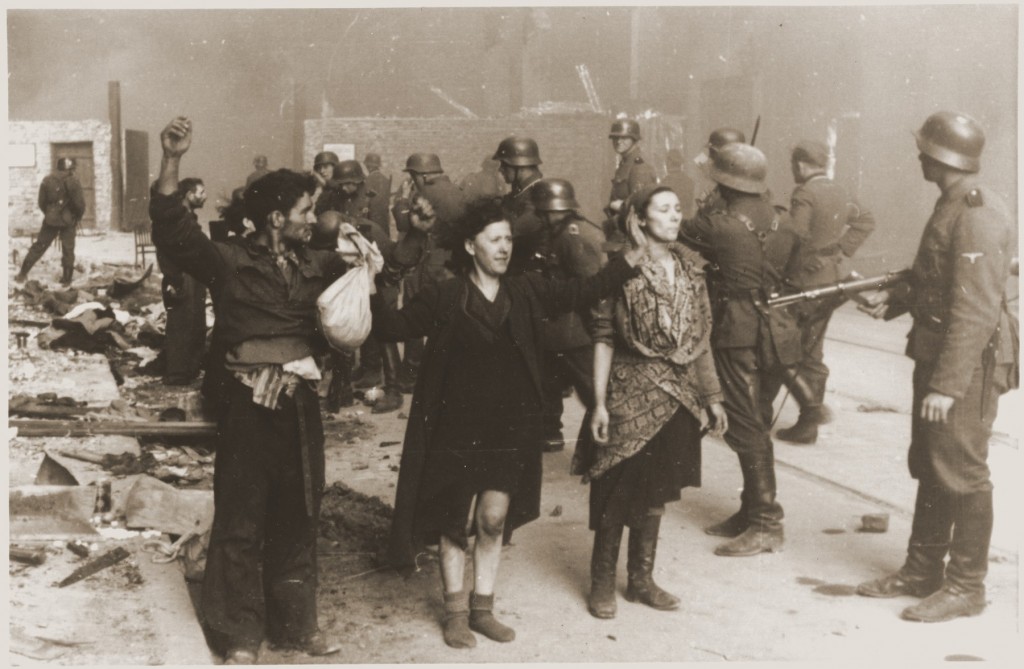
After the summer deportations, roughly 50,000–60,000 Jews remained, including many living illegally. The Jewish Fighting Organization (ŻOB) and Jewish Military Union (ŻZW) prepared armed resistance. Fighting during a January 1943 deportation changed expectations. On April 19, 1943, the final liquidation encountered the Warsaw Ghetto Uprising. German forces under Jürgen Stroop burned buildings and destroyed bunkers; the Great Synagogue was blown up on May 16, although Jews remained hidden afterward.
Sources
This page is based on institutional and scholarly sources. Media credit links point to the original source page.