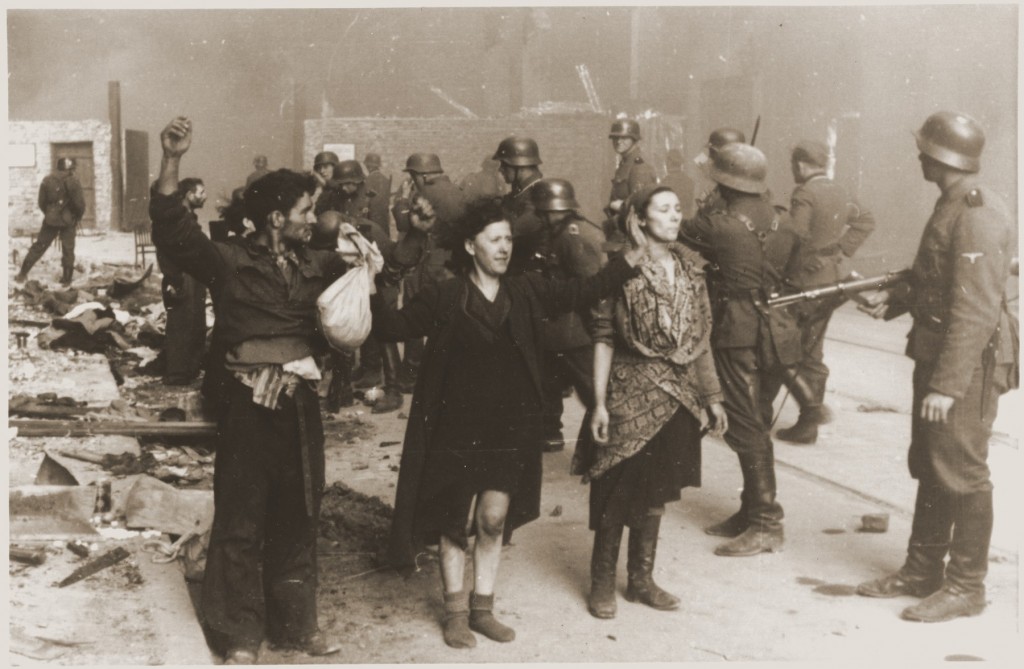
View original source at USHMM
Resistance beyond weapons
Resistance included armed revolt, escape, sabotage, smuggling, clandestine education, worship, documentation, cultural work, mutual aid and preservation of identity. Jewish armed undergrounds developed in roughly 100 ghettos. The Warsaw Ghetto Uprising began on April 19, 1943 and lasted nearly a month. Revolts also took place at Białystok, Treblinka, Sobibór and Auschwitz-Birkenau.
Partisans and escape
Jewish partisans operated in forests and underground networks. The Bielski group combined armed activity with rescue and maintained a family camp. Jews also joined Soviet and other partisan formations, though some encountered antisemitism or exclusion. Hiding required documents, food, money, silence and repeated assistance; escape could mean crossing borders, leaving a ghetto, jumping from a train or surviving under a false identity.
Rescuers
Rescue was dangerous, uneven and uncommon relative to the scale of need. Important cases include Raoul Wallenberg, Chiune Sugihara, Aristides de Sousa Mendes, Irena Sendler, Oskar Schindler, Jan and Antonina Żabiński, Nicholas Winton, Le Chambon-sur-Lignon and the rescue of Danish Jews. Yad Vashem’s Righteous Among the Nations designation recognizes non-Jews who actively rescued Jews under defined criteria. Rescue stories should be told without implying that rescue was easy or typical.
Resistance and rescue in a wider frame
Forms of resistance
Armed, documentary, spiritual, cultural and everyday resistance operated under very different conditions.
Jewish self-rescue
Families, couriers, youth movements and communal networks created hiding, false papers, border routes and mutual aid.
Partisans
Forest escape offered armed possibilities but also exposed Jews to terrain, supply problems and antisemitism in some resistance movements.
Rescue systems
Diplomatic protection, hidden children, paid hiding and underground institutions should be studied as systems rather than only heroic biographies.
Sources
This page is an educational synthesis based on the following sources. Consult the full sources for deeper research.