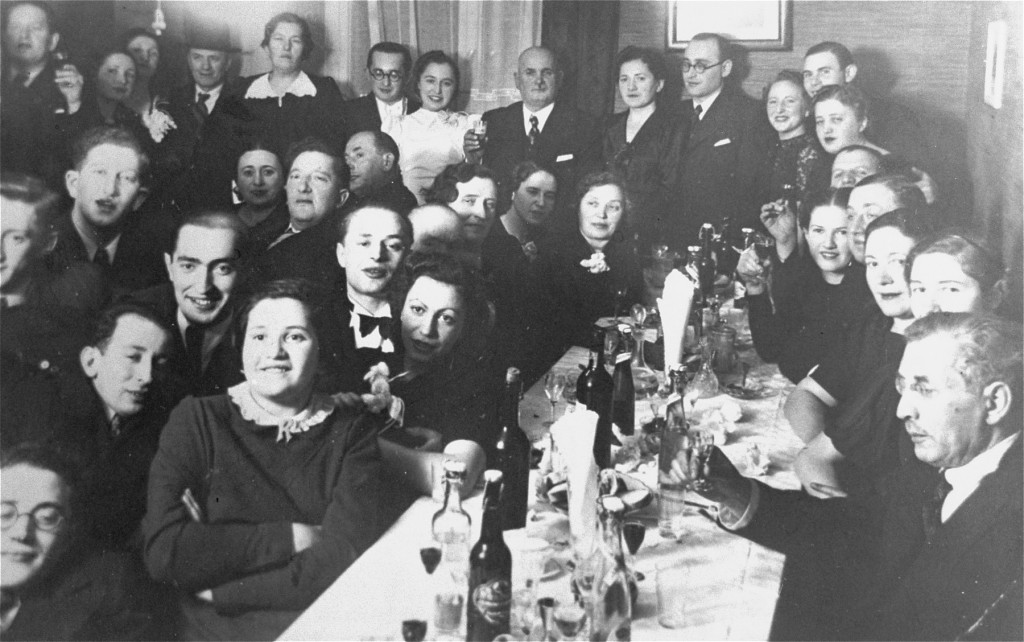
View original source at USHMM
Supported by converging records.
A reasoned range, not false precision.
Personal experience, not automatically universal.
An evidence-based argument about meaning or causation.
Definition
The Holocaust was the systematic, state-sponsored persecution and murder of six million European Jews by Nazi Germany and its allies and collaborators. The Holocaust era is commonly framed as 1933–1945. Nazi persecution began when Adolf Hitler and the Nazi Party came to power in Germany in 1933; systematic mass murder expanded decisively from 1941 and continued until the defeat of Nazi Germany in 1945.
The genocide of the Jews took place within a wider system of Nazi racial persecution and war. Nazi Germany also persecuted and murdered millions of non-Jewish people, including Roma and Sinti, disabled people, Soviet prisoners of war, Polish civilians, political opponents, Jehovah’s Witnesses, and gay men. Their histories are important and distinct; they should not be collapsed into the specifically anti-Jewish genocide.
How persecution became genocide
The Holocaust did not begin with gas chambers. It developed through escalating choices: exclusion from public life, discriminatory laws, economic dispossession, violence, forced emigration, ghettoization, deportation, forced labor, mass shootings, gas vans, and killing centers. This sequence was not inevitable. It was created by decisions made by political leaders, police, bureaucrats, military units, institutions, collaborators, and individuals.
Understanding that progression is essential. It shows how a modern state used law, propaganda, administration, transport, policing, war, and industrial resources to isolate and ultimately murder millions of people.
How we know
Knowledge of the Holocaust rests on converging evidence: Nazi documents, deportation records, censuses, railway records, photographs, surviving buildings and archaeological evidence, Jewish underground archives, diaries and letters, survivor and liberator testimony, perpetrator testimony, demographic reconstruction, and postwar trials. No single document is the “proof” of the Holocaust; the historical record is vast and mutually corroborating.
How the Holocaust unfolded
A phase-based chronology
1933–1938 exclusion; 1938–1941 radicalization and expansion; 1941–1944 systematic mass murder; 1944–1945 evacuation, death marches and liberation.
How murder occurred
Mass shootings, killing centers, starvation, forced labor, camp conditions and death marches operated across different regions.
Who implemented it
Government ministries, SS and police, military institutions, railways, businesses, occupation governments and auxiliaries all played documented roles.
How historians know
Perpetrator records, victim archives, testimony, demographics, photography, archaeology and trials converge.
Sources
This page is an educational synthesis based on the following sources. Consult the full sources for deeper research.