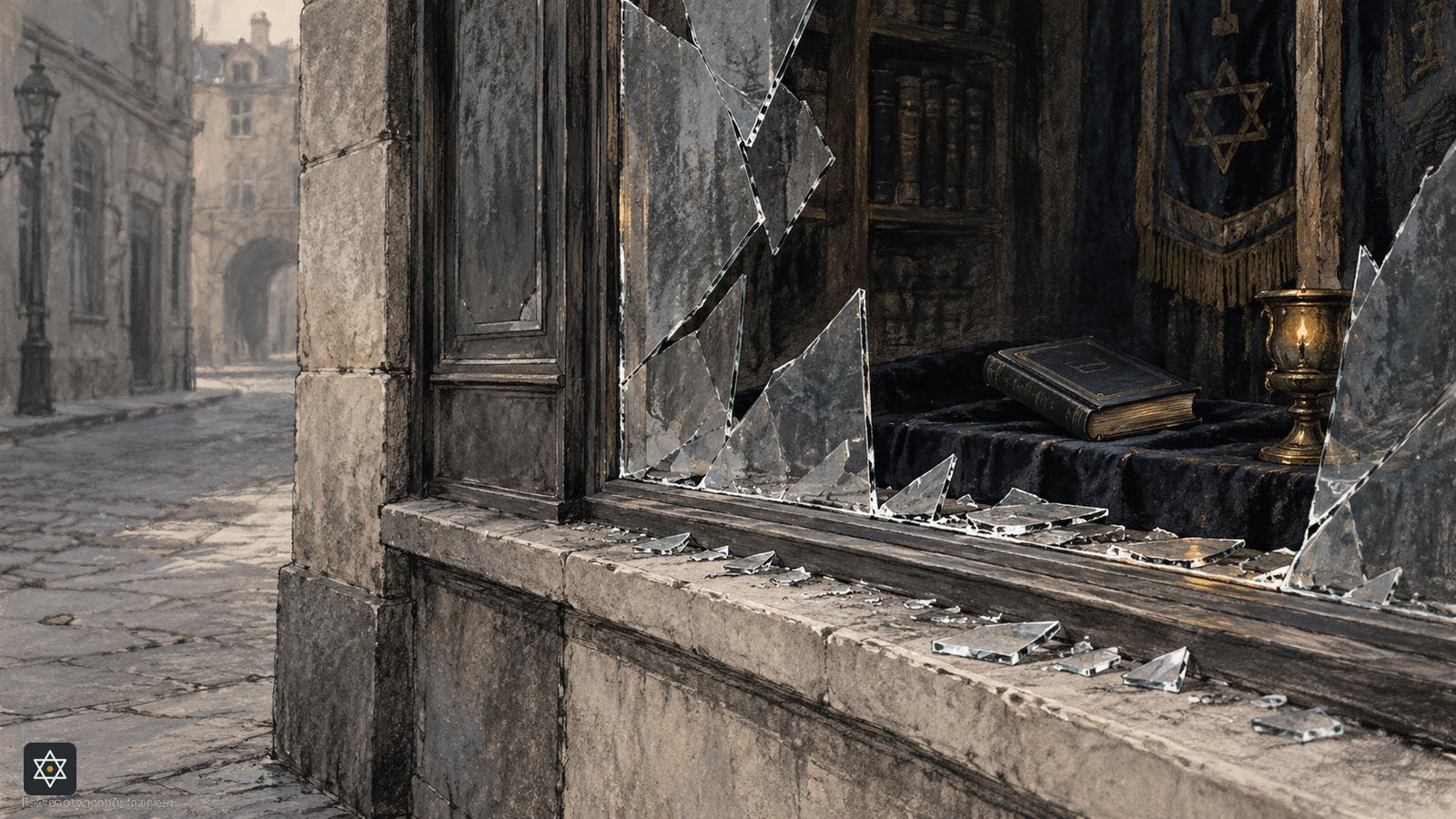
On November 9–10, 1938, Nazi leaders organized a wave of violence against Jews across Germany, annexed Austria and the Sudetenland. Synagogues were burned, businesses and homes were attacked, people were murdered, and tens of thousands of Jewish men were arrested. Known as Kristallnacht, or the November Pogrom, the assault made the connection between state power, public violence and the destruction of Jewish livelihoods unmistakable.
The shattered windows that gave Kristallnacht its name were only one part of the crime. The regime then forced Jewish communities to pay for the damage inflicted on them, accelerated the seizure of their property and intensified pressure to emigrate. Leaving required visas, money and a country willing to admit them. The pogrom therefore exposed both the danger facing Jews inside Nazi territory and the limits of refuge beyond it.
Persecution before November 1938
The pogrom did not begin Nazi antisemitism. Since 1933, the regime had excluded Jews from professions and public institutions, encouraged boycotts and used intimidation to undermine their place in German society. The Nuremberg Laws of 1935 deprived Jews of full citizenship and prohibited marriages and sexual relations between Jews and people classified as having German or related ancestry. These measures supplied legal categories that officials used to distinguish neighbors, colleagues and members of the same extended family.
Violence and legislation developed together. A dismissal from employment might follow a formal regulation, while a forced business sale could involve threats, public humiliation and administrative pressure. For Jewish families, the result was not a single moment of exclusion but a shrinking field of possible choices. The history of the rise of Nazism and persecution helps explain why November 1938 was an escalation within an established process.
Territorial expansion widened that process. Germany annexed Austria in March 1938 and the Sudetenland in the autumn. Austrian Jews experienced particularly visible humiliation and dispossession after the annexation. The same regime that expanded its borders also increased the number of Jews exposed to its persecution. Events in November must therefore be understood across the enlarged Reich, not only within Germany's pre-1938 borders.
A shooting used as a pretext
In late October 1938, German authorities expelled thousands of Jews with Polish citizenship. Among them were members of the Grynszpan family, who were forced from Hanover toward the Polish border. Their son Herschel Grynszpan, a seventeen-year-old living in Paris, learned of their plight. On November 7, he shot German diplomat Ernst vom Rath at the German embassy. Vom Rath died on November 9.
The Nazi leadership presented the shooting as justification for collective punishment. That claim must be distinguished from an explanation of responsibility. Grynszpan's act did not cause Jews throughout the Reich to attack themselves, burn their own synagogues or order their own arrests. Nazi officials chose to exploit it, directing propaganda against Jews as a group and turning one act into a pretext for organized persecution.
Party leaders were gathered in Munich on November 9 to commemorate Hitler's failed coup of 1923. After news of vom Rath's death, Joseph Goebbels delivered an inflammatory speech. Instructions passed through party networks to local organizations. The United States Holocaust Memorial Museum identifies coordination by senior Nazi leaders, with Hitler's support, rather than an uncontrolled popular uprising.
Some attacks had already occurred before the main night of violence. The dates November 9–10 identify its central nationwide phase; they should not suggest that every assault began and ended at precisely the same time. Local histories reveal differences in timing, participation and destruction within the broader state-directed campaign.
How the violence was organized
Members of the SA, SS, Hitler Youth and other Nazi organizations attacked Jewish targets. Civilians also participated, including people who looted damaged homes and shops. Other residents watched. Individual conduct varied, but the authorities' role cannot be reduced to a passive failure to maintain order: the regime encouraged and coordinated the assault.
Police instructions shaped what was attacked and what was protected. The destruction of Jewish property was permitted while danger to adjoining non-Jewish property was to be avoided. Firefighters frequently concentrated on preventing flames from spreading rather than saving synagogues. This selective protection showed that the state could act, but was choosing whom it would protect.
Synagogues were centers of worship, education, association and memory. Their destruction damaged more than buildings. Religious objects, communal records and places where generations had gathered were attacked alongside private homes and businesses. Families faced the loss of personal safety and the institutions that helped sustain community life.
Accounts of the pogrom often cite thousands of damaged businesses and more than a thousand attacked or destroyed synagogues and prayer spaces. Exact totals vary with definitions and later local research. A synagogue, a prayer room and a communal building do not necessarily appear as separate entries in every count. The extensive destruction is securely established without treating one rounded total as a complete inventory.
Arrests and the concentration camps
Police arrested tens of thousands of Jewish men and sent many to Dachau, Buchenwald and Sachsenhausen. These arrests made Jewish identity itself the basis for mass incarceration. The men included people who had no connection to Grynszpan and had committed no offense. Their detention was part of the attack, not a lawful investigation into the Paris shooting.
Published institutional accounts distinguish arrests from the number subsequently imprisoned in concentration camps. The current USHMM overview gives about 26,000 men sent to camps; the widely used figure of approximately 30,000 describes the mass arrests in other accounts. These are estimates with different scopes, not individual-level lists that can be substituted without explanation.
Prisoners suffered violence, humiliation, deprivation and deaths in custody. Release was often tied to proof of plans to leave Germany and could also involve the surrender of property. Families outside the camps sought documents, foreign contacts and financial guarantees while trying to discover where their relatives were held. A release did not restore security or rights.
The arrests also demonstrate why the concentration camp system must be studied over time. The camps already existed before the pogrom. In November 1938 they became instruments of a much broader anti-Jewish operation. Their function at this stage should not simply be equated with that of the later killing centers.
The victims were made to pay
After the attacks, the regime intensified economic persecution. At a meeting chaired by Hermann Göring on November 12, officials discussed measures that transferred the costs of the pogrom to the Jewish population. A collective levy of one billion Reichsmarks was imposed on Jews. Insurance payments for damaged Jewish property were diverted to the state, while victims were required to repair damage.
The term used by the authorities, an “atonement payment,” expressed the fiction of collective Jewish guilt. It was an instrument of punishment and dispossession, not compensation for a genuine debt. Describing the measure in the regime's language without explanation would repeat its justification rather than identify what it did.
Further restrictions excluded Jews from economic activity and increased pressure to transfer businesses to non-Jewish ownership. This process is often called “Aryanization,” another ideological term that requires explanation. It could involve a nominal sale, but a sale under coercion and discriminatory restrictions was not an ordinary market transaction. The broader history of Jewish property confiscation connects the destruction in the streets with the administrative seizure that followed.
Foreign responses and the limits of escape
The pogrom attracted extensive international attention. Foreign correspondents, diplomats, religious organizations and Jewish communities reported or protested the violence. In the United States, President Franklin D. Roosevelt recalled the American ambassador for consultations. Public condemnation, however, did not automatically change immigration laws or create enough places of refuge.
Britain permitted the admission of unaccompanied refugee children through the rescue efforts known as the Kindertransport. Approximately 10,000 children, most of them Jewish, reached Britain through those efforts between late 1938 and 1940. Their rescue was significant, but parents generally could not accompany them under the scheme. For many families, an opening for a child meant separation rather than safety together.
Emigration required a sequence of permissions. A person needed to leave Nazi-controlled territory, cross or transit other countries and gain admission to a destination. Financial demands increased as persecution destroyed the resources needed to satisfy them. It is therefore misleading to ask only why families did not leave. The historical question is what avenues were actually available to a particular person at a particular time.
Why the name matters
Kristallnacht refers to the glass from shattered windows. It remains a widely recognized historical term, but it can direct attention toward damaged property rather than murdered people, assault and incarceration. “November Pogrom” identifies the event as organized anti-Jewish violence and avoids allowing broken glass to stand for the entire crime.
Using both names can help readers connect familiar terminology with a fuller understanding. Neither name should conceal the perpetrators or portray the violence as spontaneous. Nor should the event be described as the beginning of all persecution or as identical to the later systematic murder of European Jewry. Its significance lies in the particular transformation it marked: nationwide public violence, mass detention and accelerated economic exclusion combined under state direction.
The Holocaust timeline places that transformation between earlier legal persecution and the wartime expansion of deportation and murder. November 1938 did not make every later development inevitable. It showed what the regime was already prepared to do, how institutions enabled it and how little protection Jewish citizenship, property ownership or longstanding membership in society could still provide.
Local and national evidence illuminate one another. An instruction issued across the country explains the framework of the violence, while the history of a particular family or synagogue shows how it was carried out. Without that framework, a local attack can appear isolated; without individual histories, the people targeted can disappear behind descriptions of institutions and regulations.
Sources
- United States Holocaust Memorial Museum, Kristallnacht, Holocaust Encyclopedia, undated web article
- United States Holocaust Memorial Museum, The Night of Broken Glass, Holocaust Encyclopedia, undated web article