View original source at USHMM
Different institutions
A concentration camp was an extrajudicial detention and terror institution that increasingly became tied to forced labor and lethal conditions. A killing center was created primarily for mass murder on arrival. Bełżec, Sobibór, Treblinka and Chełmno were not ordinary concentration camps. Auschwitz-Birkenau combined concentration-camp, forced-labor and killing-center functions. Majdanek was a concentration and forced-labor camp where mass murder also occurred.
The five principal killing centers
The five principal killing centers used for the mass murder of Jews by poison gas were Chełmno, Bełżec, Sobibór, Treblinka and Auschwitz-Birkenau. Approximately 2.7 million Jews were murdered at these sites. Treblinka, Sobibór and Bełżec formed the core of Operation Reinhard. Chełmno used gas vans. Auschwitz-Birkenau became the largest killing center.
Other major concentration-camp systems
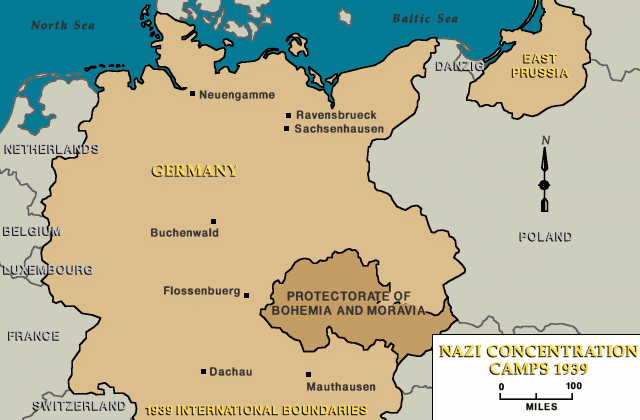
Dachau became the principal early model for the SS concentration-camp system. Buchenwald, Sachsenhausen, Mauthausen, Flossenbürg, Neuengamme and Dora-Mittelbau developed extensive networks of forced-labor subcamps. Ravensbrück was the principal concentration camp for women. Bergen-Belsen evolved through several functions and became a site of catastrophic death from starvation and disease, not a killing-center gas-chamber complex.
Camp types and functions
Camp categories
Concentration camps, killing centers, transit camps, forced-labor camps and POW camps were not interchangeable institutions.
Changing functions
Camps evolved over time, creating overlapping functions that require date-specific explanation.
Killing centers
Chełmno, Bełżec, Sobibór, Treblinka and Auschwitz-Birkenau had central mass-murder roles; Majdanek had a different institutional history.
Forced labor and murder
Temporary labor selection could postpone death without altering genocidal policy.
Sources
This page is an educational synthesis based on the following sources. Consult the full sources for deeper research.