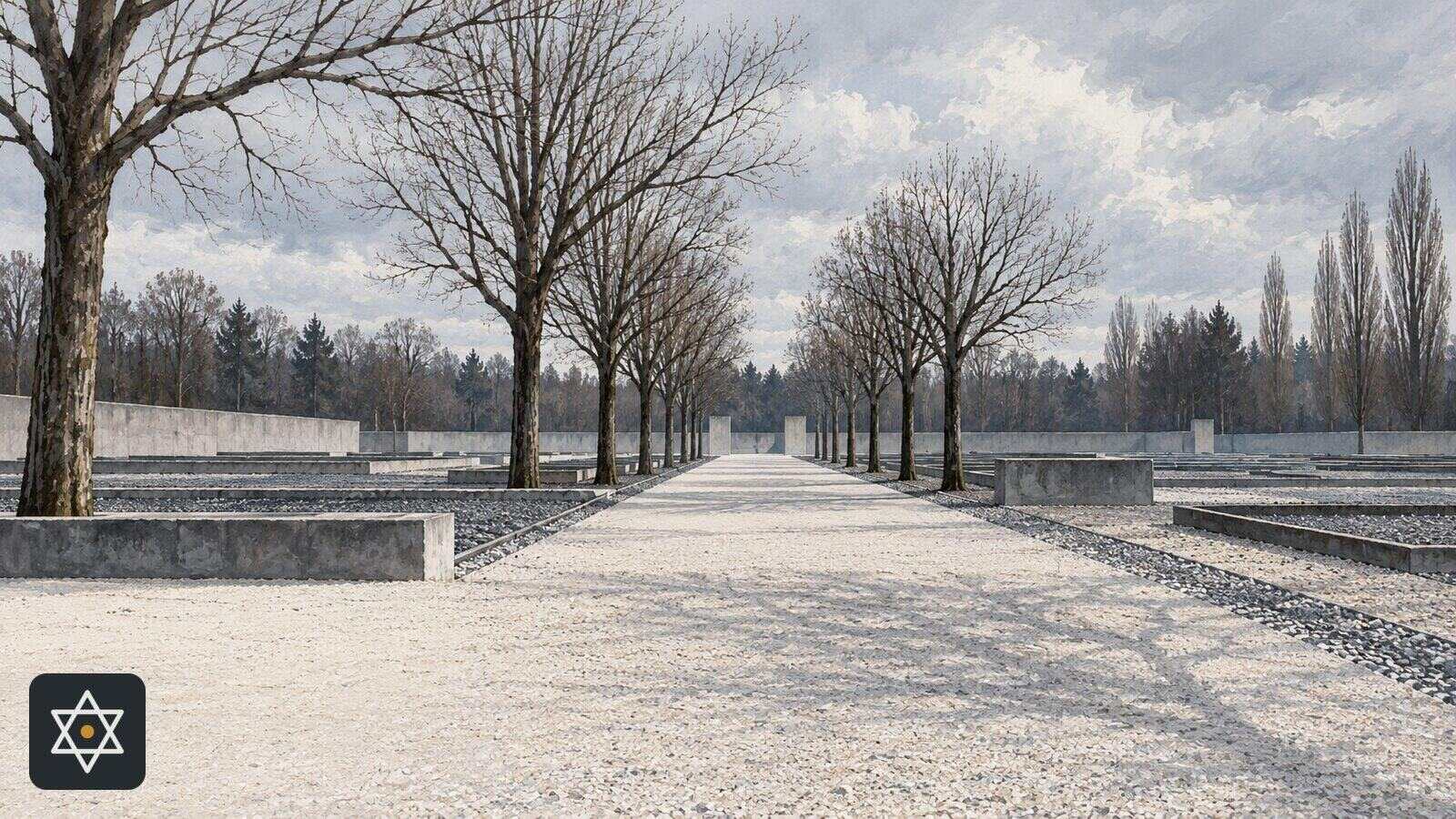
Dachau opened on March 22, 1933, near Munich, less than two months after Adolf Hitler became German chancellor. The first regular concentration camp established by the Nazi government became a place for imprisoning political opponents, a training ground for guards, and a model for the expanding SS camp system. It operated until American forces liberated it on April 29, 1945.
Its history spans the dictatorship's beginnings and the catastrophic final months of the war. The Dachau Memorial places the number imprisoned in the main camp and its subcamps at more than 200,000 and the death toll at at least 41,500. Those figures describe a changing network of imprisonment and forced labor, not only the enclosure that visitors encounter today.
A camp created to secure the dictatorship
The Nazis established Dachau in a disused gunpowder and ammunition factory. Its first prisoners were primarily political opponents, including Communists and Social Democrats. Detention removed people from ordinary legal protection and placed them under a system in which guards could punish and abuse them with little prospect of accountability.
Calling Dachau the first regular concentration camp does not mean it was the first location where Nazis detained or tortured people. Numerous improvised detention sites appeared during the seizure of power. Dachau's particular importance was its continued operation and the institutional system developed there. Its early history belongs within the wider rise of Nazism and persecution.
The camp also made intimidation visible beyond its fences. Arrest could remove an opponent from public life while warning others about the consequences of dissent. Imprisonment was therefore both an assault on the person detained and an instrument for consolidating the new dictatorship.
How Dachau became a model
Under commandant Theodor Eicke, regulations formalized punishment, guard duties and the relationship between the SS and prisoners. The system gave bureaucratic form to terror. Written rules did not protect prisoners from arbitrary violence; they organized the authority of those who inflicted it.
Dachau also trained SS personnel. Practices and personnel moved through the growing network of camps, carrying methods of surveillance, humiliation and coercion with them. The camp's influence cannot be measured solely by the number of people confined inside it. Its arrangements helped shape conditions elsewhere.
The distinction between camp types remains essential. Dachau was a concentration camp and a site of mass death and murder. It was not established as a killing center for the immediate murder of entire deportation transports. The broader guide to camps and killing centers explains these categories without implying that concentration camps were safe or that their functions never changed.
The prisoners changed as persecution expanded
Political opponents remained part of the prisoner population, but Nazi persecution brought other groups into the camp: Jews, Jehovah's Witnesses, men persecuted as homosexuals, and people stigmatized through Nazi social and criminal classifications. Such labels expressed the regime's judgments; they are not neutral descriptions of the people imprisoned.
The November 1938 pogroms marked a major change. Jewish men were arrested in large numbers and sent to concentration camps, including Dachau. Imprisonment formed part of the pressure to dispossess Jews and force their emigration. Some were subsequently released, but release depended on decisions made by their persecutors and did not restore the security they had lost. This episode is examined more fully in the page on Kristallnacht.
War expanded the camp's reach across occupied Europe. Prisoners arrived from different countries, with different languages, histories and reasons for arrest. Some had already endured other camps. Treating the prisoners as one undifferentiated group obscures both Nazi hierarchies and the different routes through which people reached Dachau.
Forced labor and the subcamp network
Dachau developed into a system extending beyond the main camp. Subcamps supplied prisoners for construction and industrial work, including projects serving the German war economy. In the later war years, the demand for labor brought large numbers of Jewish prisoners into this network, including the Kaufering and Mühldorf complexes.
Being classified as useful for labor offered no reliable protection. Food, shelter and medical care were subordinated to exploitation, while punishment and exhaustion endangered prisoners daily. Work assignments could determine whether someone had any realistic chance of surviving the next weeks.
This geographical expansion also changes how records should be read. A document naming Dachau may concern the main camp, administrative registration, or imprisonment in a distant subcamp. Family researchers need the sequence of transfers and work locations, rather than assuming that a single camp name describes the person's entire experience.
Medical experiments and other forms of murder
German physicians subjected prisoners to experiments without consent. USHMM documents experiments involving high altitude, extreme cold, seawater and infectious diseases. These were abuses of captive people, carried out within a system that denied them the ability to refuse. Prisoners died or suffered lasting injury.
Dachau prisoners were also executed or transferred elsewhere to be killed. Those selected as unable to work could be sent to the Hartheim killing center in Austria. The existence of several killing methods and destinations is another reason not to reduce the camp's history to a single building or facility.
The sources do not provide one perfectly complete count of every death. USHMM states that scholars estimate at least 40,000 prisoners died at Dachau, noting gaps involving people brought for execution and deaths during evacuation. The Dachau Memorial's historical overview gives at least 41,500 victims. These are attributed estimates, not competing claims that the exact total is known.
Evacuation, liberation and the trials
In the final months, transports from other camps brought further overcrowding and disease. The approach of Allied forces did not end the danger. The SS forced prisoners onto evacuation trains and death marches; people died from exhaustion, exposure, hunger and killings along the routes.
American troops liberated the main camp on April 29, 1945. Liberation ended SS control but could not immediately reverse starvation and illness. Survivors needed treatment, food and a place to recover. Many also faced the uncertainty of discovering what had happened to relatives and whether a home remained to which they could return.
The name Dachau subsequently became associated with American military trials held at the former camp. Beginning in November 1945, these proceedings addressed crimes committed at Dachau and elsewhere. They should be distinguished from the International Military Tribunal at Nuremberg, and from the narrower trial of the Dachau camp staff within the larger Dachau trial program.
Today, the historical site, surviving records and testimony illuminate different parts of the same system. The buildings explain space; documents trace decisions and transfers; survivors describe experiences that administrative records often concealed. Reading them together makes Dachau's role clearer: a camp that helped establish the machinery of persecution and continued to destroy lives until the dictatorship's final days.