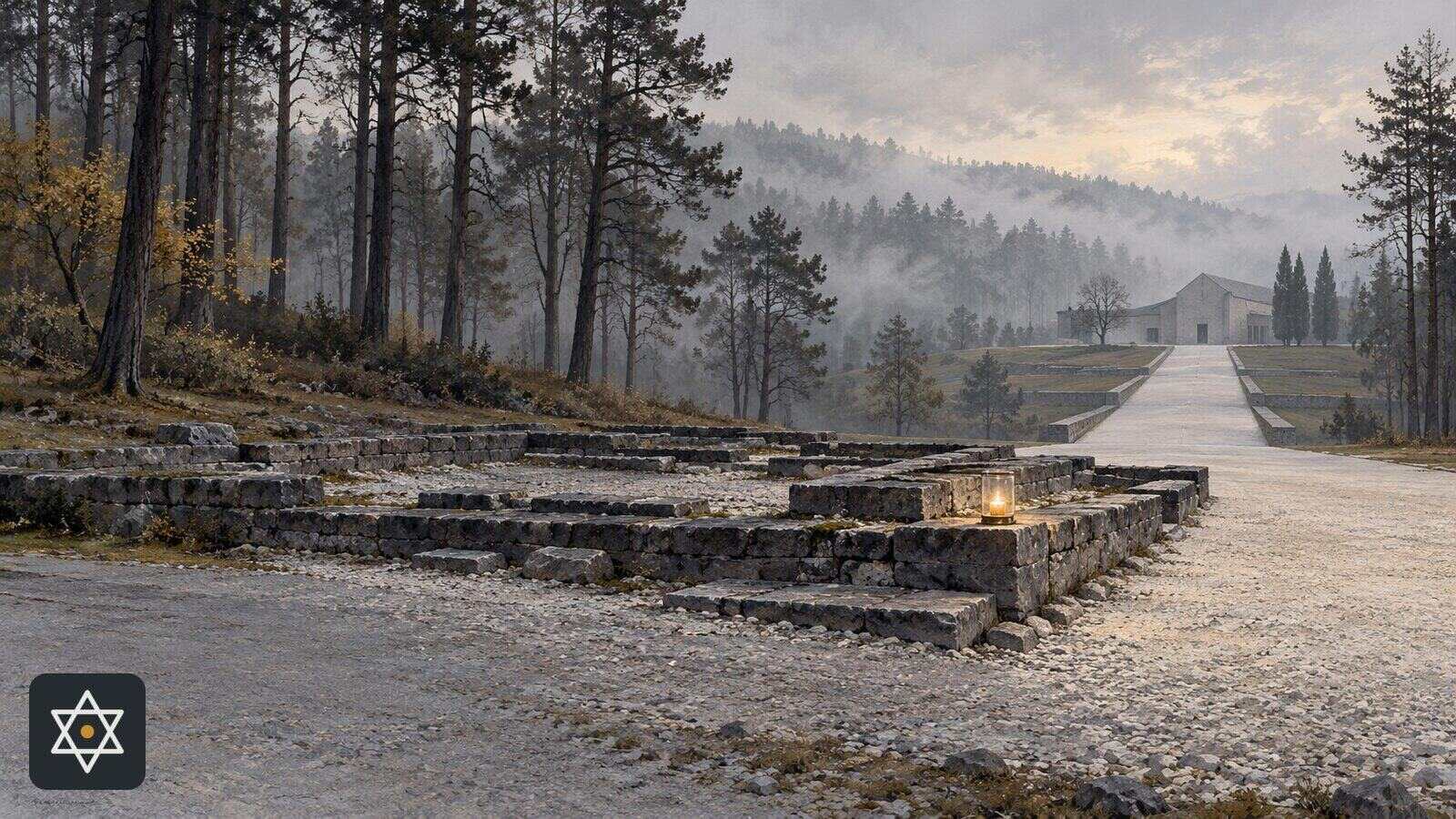
Buchenwald was a Nazi concentration camp established in July 1937 on the Ettersberg near Weimar, Germany. It became the center of a large forced-labor network and, in the final months of the war, a destination for prisoners evacuated from camps farther east. Its history includes systematic killing, the rescue of children by fellow prisoners, clandestine organization, and liberation on April 11, 1945.
The Buchenwald Memorial records approximately 277,800 prisoners across the camp system and about 56,000 deaths. These totals cover years of imprisonment and many locations. They should not be confused with the roughly 21,000 people still in the main camp when it was liberated.
A camp above Weimar
The first prisoners arrived on July 15, 1937. The SS established Buchenwald close to a city associated with German literature and cultural life. The camp was nevertheless part of an expanding system designed to isolate, exploit and terrorize people whom the Nazi regime defined as enemies or outsiders.
Prisoner groups included political opponents, Jehovah's Witnesses, Jews, Roma and Sinti, men persecuted as homosexuals, and people assigned stigmatizing social or criminal classifications. These categories shaped how the SS treated prisoners. They were instruments of persecution, not reliable descriptions of a person's conduct or character.
As Germany occupied more countries, Buchenwald's prisoner population became increasingly international. Its history therefore cannot be told only as a German domestic story. Deportation connected the main camp and its satellite camps to persecution and resistance across Europe. The general page on camps and killing centers places that expansion in context.
Jewish imprisonment after the November pogroms
After the November 1938 pogroms, German police and the SS sent almost 10,000 Jewish men to Buchenwald. USHMM describes extraordinarily violent treatment and hundreds of deaths. The arrests were part of an effort to drive Jews out of economic and public life and pressure them to leave Germany.
The experience of these men differed from that of Jews deported during the later war years. Some were released after a period of imprisonment, often in circumstances connected to emigration. That possibility did not make the imprisonment less coercive, nor did it provide safety for those whose attempts to leave failed. The chronology matters because Nazi persecution changed in its methods and objectives.
The page on Kristallnacht explains the wider pogrom and arrests. Within Buchenwald, this episode shows how a concentration camp could serve several connected purposes: punishment, intimidation, dispossession and the enforcement of exclusion.
Forced labor and a widening camp system
Prisoners worked under brutal conditions, and the camp became closely connected to wartime production. Satellite camps spread imprisonment beyond the Ettersberg. Women as well as men were confined within the wider system, although the familiar images of the main camp often obscure that geographical and human range.
Administrative totals must therefore be handled carefully. The memorial's figures include people registered in the camp system, not a population that was present in one place at one moment. Transfers also mean that an individual's route might include several camps and different prisoner numbers.
Exploitation did not protect those who could work. Food deprivation, disease, punishment and murder remained part of the system. Nor did a prisoner functionary's position imply freedom: the SS assigned some prisoners responsibilities over others, creating unequal access to resources and difficult possibilities for either abuse or assistance.
The Little Camp and the final evacuations
The SS established the Little Camp as a quarantine area in 1943. It became a place through which newly arrived prisoners passed before transfer to work elsewhere. Its barracks and sanitary arrangements were radically inadequate for the numbers eventually held there.
In early 1945, transports from Auschwitz and Groß-Rosen brought people already weakened by imprisonment, hunger and evacuation. The Little Camp became catastrophically overcrowded. According to the memorial, approximately 6,000 prisoners died there between January and April 1945, most of them Jews brought from those eastern camp systems.
These deaths were not simply the result of a disorderly end to the war. They occurred within a system that continued moving and confining prisoners while denying them conditions necessary for survival. The approach of liberation could coincide with a sharp increase in danger.
Children, protection and the clandestine organization
In January 1945, prisoner functionaries and Jewish prisoners established a children's block in Barracks 66 in the Little Camp. The memorial describes it as a place where hundreds of children and adolescents were protected. Its location inside a zone of extreme mortality makes the achievement especially significant.
Protection required practical acts: keeping young prisoners together, securing assistance and limiting exposure to dangerous assignments. These efforts should not be transformed into a claim that every child was safe or that all prisoners had equal access to protection. The evidence concerns particular people acting under severe constraints.
Clandestine groups also exchanged information, organized solidarity and prepared for a confrontation with the SS. The International Camp Committee brought together representatives of several national groups. Resistance and prisoner self-help overlapped, but they were not identical. Caring for a child, preserving information and acquiring a hidden weapon involved different risks and possibilities. The broader history of children and women during the Holocaust helps place these experiences beyond a single camp.
April 11: liberation from outside and action within
The Buchenwald Memorial's account of liberation describes the interaction between the advancing US Army and armed prisoners. As American armored forces reached the area, SS personnel withdrew or were overcome. Prisoners mobilized, distributed hidden weapons and took control inside the camp. American scouts then entered.
The sequence matters. A description that removes the US military advance misrepresents the circumstances that broke SS control. A description that omits prisoner action erases the organization and decisions of those inside. The memorial therefore presents liberation as involving both forces.
About 21,000 people were liberated, including some 900 children and adolescents. Those figures describe the remaining main-camp population. Many other prisoners had already been driven away on death marches, and liberation did not immediately end the consequences of illness and starvation.
What the American documentation records
US Army photographers documented conditions and survivors after liberation. The memorial identifies photographs by the 166th Signal Photo Company among the images that became internationally known. Their evidentiary importance includes the conditions they recorded and the dates and locations that can be established.
A liberation photograph is nevertheless a record of a particular moment. It cannot by itself show the entire history of an institution operating since 1937, the experience of every subcamp, or the lives of those who had already died or been evacuated. Captions and provenance are essential to responsible use.
Buchenwald's history emerges from combining these images with camp documents, testimony and research into the underground organization. Together, they show the camp's changing functions and the limited but consequential spaces in which prisoners helped one another. The survival of children and the destruction of thousands of other lives belong to the same history; neither should displace the other.