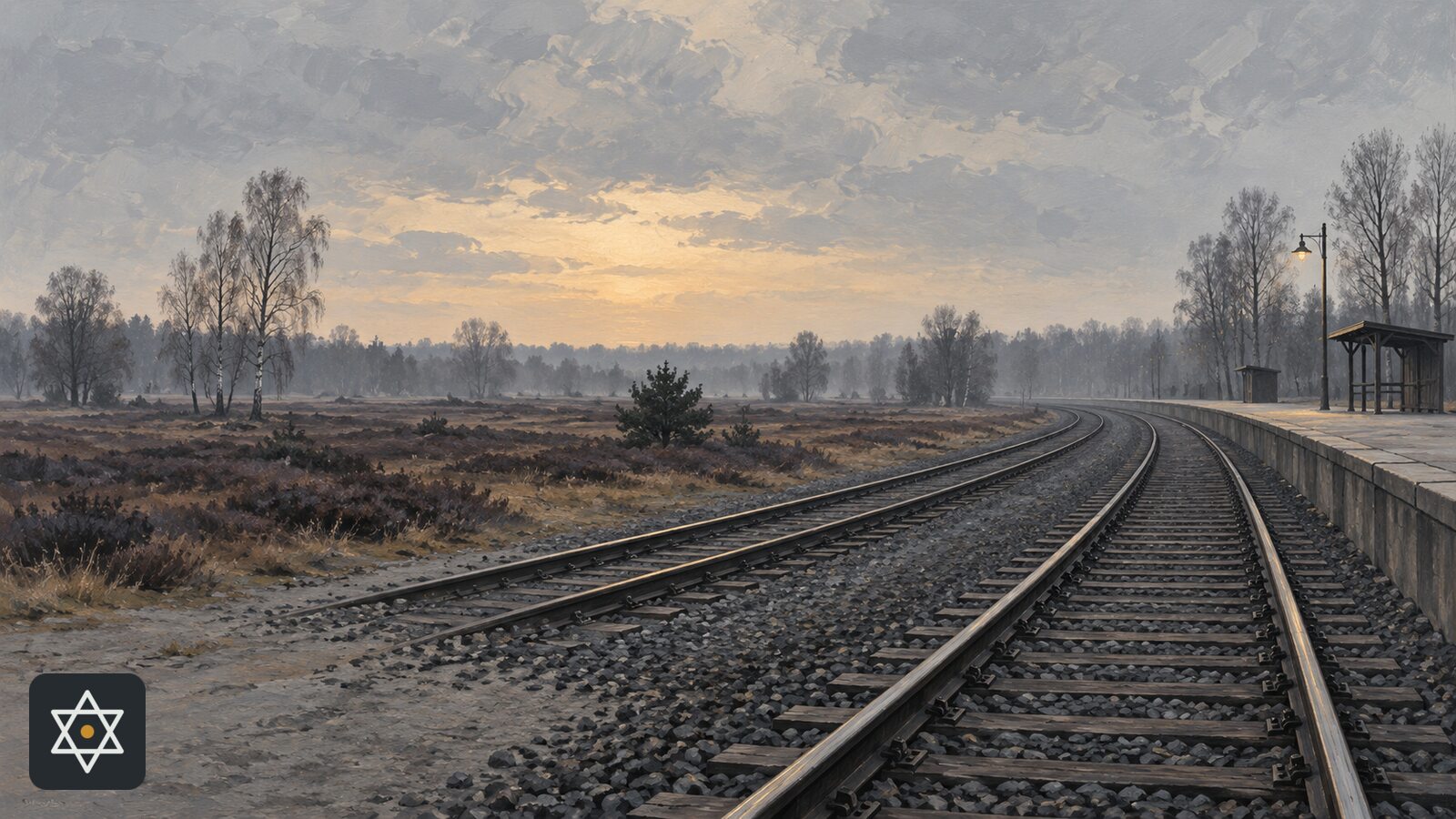
Westerbork began in 1939 as a Dutch camp for Jewish refugees and became, under German control, the principal transit camp for the deportation of Jews from the occupied Netherlands. Its barracks, workshops, hospital and cultural activities existed alongside the recurring threat of a transport east. A temporary reprieve could postpone deportation without ending the danger.
The Camp Westerbork Memorial Centre describes approximately 107,000 Jewish deportees passing through the camp, alongside Sinti, Roma and other prisoners. Its public exhibition states that 102,000 of those deported were murdered. These institutional totals convey the scale of the catastrophe; individual transport lists provide the more precise starting point for tracing a particular person.
A refugee camp before the occupation
The Dutch government established Westerbork in 1939 for Jewish refugees, principally people who had fled Germany. The first residents arrived in October. They had escaped Nazi persecution but had not necessarily obtained permanent security or the right to settle freely where they wished.
Germany invaded the Netherlands in May 1940. Westerbork initially remained under Dutch administration. Its later transformation was therefore not the creation of a camp on empty ground, but the conversion of an existing institution and its population into a tool of occupation policy.
This sequence is important for understanding the Holocaust in the Netherlands. Refuge, registration, restriction and deportation did not always occur in separate places. For some refugees, the place intended to contain their uncertain situation became a stage in their renewed persecution.
The German takeover and the transport system
German officials took over Westerbork in July 1942 and made it a police transit camp. The first deportation to Auschwitz-Birkenau left on July 15. Further transports went to Sobibór, Theresienstadt and Bergen-Belsen, with smaller transports to other camps.
The schedule changed over time. Early transports departed more than once a week; Tuesday became the usual transport day during 1943. The last major transport departed on September 13, 1944. It would therefore be misleading to suggest that a train left every Tuesday without interruption throughout the camp's existence.
Berlin determined transport destinations and scheduling, while the commandant controlled the selection of deportees in the camp. Administrative work, policing and rail operations connected Westerbork to a much larger system. The page on railway deportations explains how such movements depended on coordinated institutions rather than trains alone.
Camp society under the threat of selection
Westerbork contained workshops, medical services and cultural activities. Some prisoners remained for months or longer; others were deported shortly after arrival. Work assignments and temporary exemptions could affect the length of a stay, creating a hierarchy of insecurity inside the camp.
The SS placed many daily functions in prisoners' hands. Jewish administrative workers and an order service operated under German authority. Such arrangements created possibilities for assistance but also forced prisoners into decisions and tasks within the deportation machinery. They must be understood within the coercive conditions imposed by the perpetrators.
An exemption was not equivalent to safety. Its value depended on whether the authorities continued to recognize it. A family could invest hope in a document, a job or a contact and still find its names included on a later transport. The uncertainty was a defining feature of camp life, even when a photograph showed an apparently ordinary activity.
What the 1944 film shows
In spring 1944, commandant Albert Gemmeker commissioned the imprisoned Jewish photographer Rudolf Breslauer to film the camp. The surviving footage includes work, recreation, medical facilities and a deportation train. The intended film was never completed in its planned form.
UNESCO's account of the Westerbork films explains that the project was commissioned for public-relations purposes, possibly to demonstrate the camp's economic value. The footage therefore records real people and activities through an assignment shaped by the commandant. It is not a neutral survey of everything prisoners experienced.
The scenes of departure acquired a different significance after the war. They became visual evidence of deportation and have been widely used in documentaries. Responsible interpretation preserves the original setting, filming date and coercive circumstances. It also distinguishes what the camera actually records from what later evidence establishes about the deportees' fate.
Anne Frank in Westerbork
Anne Frank, her family and the other people arrested in the Secret Annex arrived on August 8, 1944. The Anne Frank House identifies their accommodation as Punishment Barrack 67. Because they had been arrested in hiding, the authorities classified them as punishment cases and imposed additional restrictions.
They were deported to Auschwitz-Birkenau on September 3, 1944, on the final transport from Westerbork to that destination. That is different from the last transport from Westerbork altogether. Other destinations remained part of the deportation schedule after the Auschwitz train left.
The page on Anne Frank follows her wider life and persecution. Her passage through Westerbork also helps explain the experience of many less widely known prisoners: arrest was followed by registration, classification, confinement and inclusion on a transport list. The bureaucracy organized the movement of people while obscuring the violence of what it was doing.
Numbers, destinations and the fate of deportees
The memorial's digital collection describes nearly 107,000 Jews deported via Westerbork, as well as 245 Sinti and Roma and several dozen resistance prisoners. Its exhibition uses the rounded formulation of more than 107,000 people deported and 102,000 murdered. Different public presentations should be quoted with their stated scope rather than merged into a new exact total.
Auschwitz-Birkenau and Sobibór were the main killing destinations. Transports to Theresienstadt or Bergen-Belsen followed different immediate routes of imprisonment, but those destinations also exposed deportees to persecution, deprivation and death. Destination alone cannot establish an individual's eventual fate.
The memorial's outgoing-transport collection offers a route into the surviving records. Names, dates and destinations need to be matched carefully, especially where spellings differ or people were transferred again after arrival. A transport list documents deportation; a complete biography requires further evidence.
Liberation and the site's later history
Westerbork was liberated on April 12, 1945. The absence of continuing mass transports in the preceding months did not mean the people remaining there had been free. They were still confined until German control ended.
The site remained in use after the war, first for other forms of confinement and accommodation and later as the Schattenberg residential camp for Moluccan families. These later histories should not be mistaken for evidence about wartime Jewish imprisonment, but they help explain why much of the original camp changed or disappeared.
Today, memorials and names read at the site connect the scale of deportation to individual lives. Westerbork's history is particularly revealing because the machinery of persecution operated through institutions that could appear ordinary: offices, workshops, medical rooms and railway timetables. Their presence did not soften the camp's purpose. They helped make repeated deportation possible.
Sources
- Camp Westerbork: outgoing transport collection
- Camp Westerbork: permanent exhibition
- USHMM: Westerbork
- UNESCO Memory of the World: Westerbork films
- Anne Frank House: arrival and imprisonment at Westerbork
- USHMM: Anne Frank biography
- Camp Westerbork: memorial grounds
- Netherlands Institute for Sound and Vision: Westerbork film research