Anne Frank was a Jewish girl born in Frankfurt am Main on June 12, 1929, who became a writer while hiding from Nazi persecution in Amsterdam. Her diary records life in the Secret Annex, her relationships, her ambitions and her reflections on the world outside. After her arrest on August 4, 1944, she was deported through Westerbork to Auschwitz-Birkenau and later to Bergen-Belsen, where she died in 1945. Her father, Otto Frank, survived and helped bring her writing to publication.
The diary is both a personal document and a literary work that Anne herself began revising for future readers. It is not a record of her deportation or final months, which must be reconstructed from other evidence. Keeping those distinctions clear allows readers to recognize her as a particular person and an emerging author, while understanding the persecution that killed her. Her fame should open a path into Holocaust history rather than replace that history with a single familiar story.
From Frankfurt to Amsterdam
Anne was the younger daughter of Otto and Edith Frank; her sister Margot was three years older. The family left Germany after the Nazis came to power in 1933 and settled in Amsterdam. The move offered distance from escalating antisemitic persecution, but it also required rebuilding a household and livelihood in another country. Otto established a business, and the children learned Dutch and attended school. Anne formed friendships and developed interests that would later appear in her writing.
This part of her life matters because she did not begin as a symbol of persecution. She was a child in a family, a school pupil and a friend. Photographs and correspondence from before hiding preserve a social world that the diary alone cannot fully reconstruct. The history of Jewish Amsterdam places the Franks within a diverse urban community rather than presenting them as an isolated household whose fate unfolded without a wider setting.
Germany invaded the Netherlands on May 10, 1940. Under occupation, anti-Jewish measures progressively restricted education, employment, movement and access to public places. Anne was required to attend a Jewish school, and the family faced the growing threat of deportation. Restrictions that appear separately in a legal chronology accumulated in everyday life: a route, friendship, purchase or school activity that had once been ordinary became forbidden or dangerous.
The family's situation was part of the Holocaust in the Netherlands, in which German occupation authorities and their collaborators registered, isolated and deported Jews. Hiding was one possible response, but it required space, money, helpers and sustained secrecy. These resources were unevenly available. The existence of the Franks' hiding place should not create the impression that every endangered family could have made the same choice.
Eight people in the Secret Annex
On July 5, 1942, Margot received a summons for what the authorities presented as labor service. The family went into hiding the next day, earlier than planned. Their refuge was the rear annex of Otto's business premises at Prinsengracht 263. The four Franks were joined by Hermann and Auguste van Pels and their son Peter, and later by the dentist Fritz Pfeffer. Eight people ultimately shared the confined space.
Helpers connected with the business supplied food, news and other necessities. Miep Gies and Bep Voskuijl were among those who maintained this essential connection to the outside. Assistance was not one dramatic act followed by safety. It involved repeated practical decisions under occupation, including obtaining supplies and managing the risks of discovery. The people in hiding depended on these continuing efforts while remaining unable to control what happened beyond their rooms.
Daily routines were shaped by the need to avoid being heard by people working in the building. Movement and noise had to be restricted at particular times. Limited space intensified ordinary disagreements about habits, privacy and responsibility. Anne wrote about family tensions and about her changing relationship with Peter. These observations should not be treated as a complete, impartial verdict on every person she described. They are the perspective of a young writer living under sustained pressure.
The annex also contained study, reading, humor and plans for the future. Such activities were not separate from the history of persecution; they were ways people tried to maintain life within it. The absence of immediate arrest for more than two years did not remove fear. News from outside could bring hope or dread, while the possibility of discovery remained beyond the occupants' control.
A diary and an author's deliberate revision
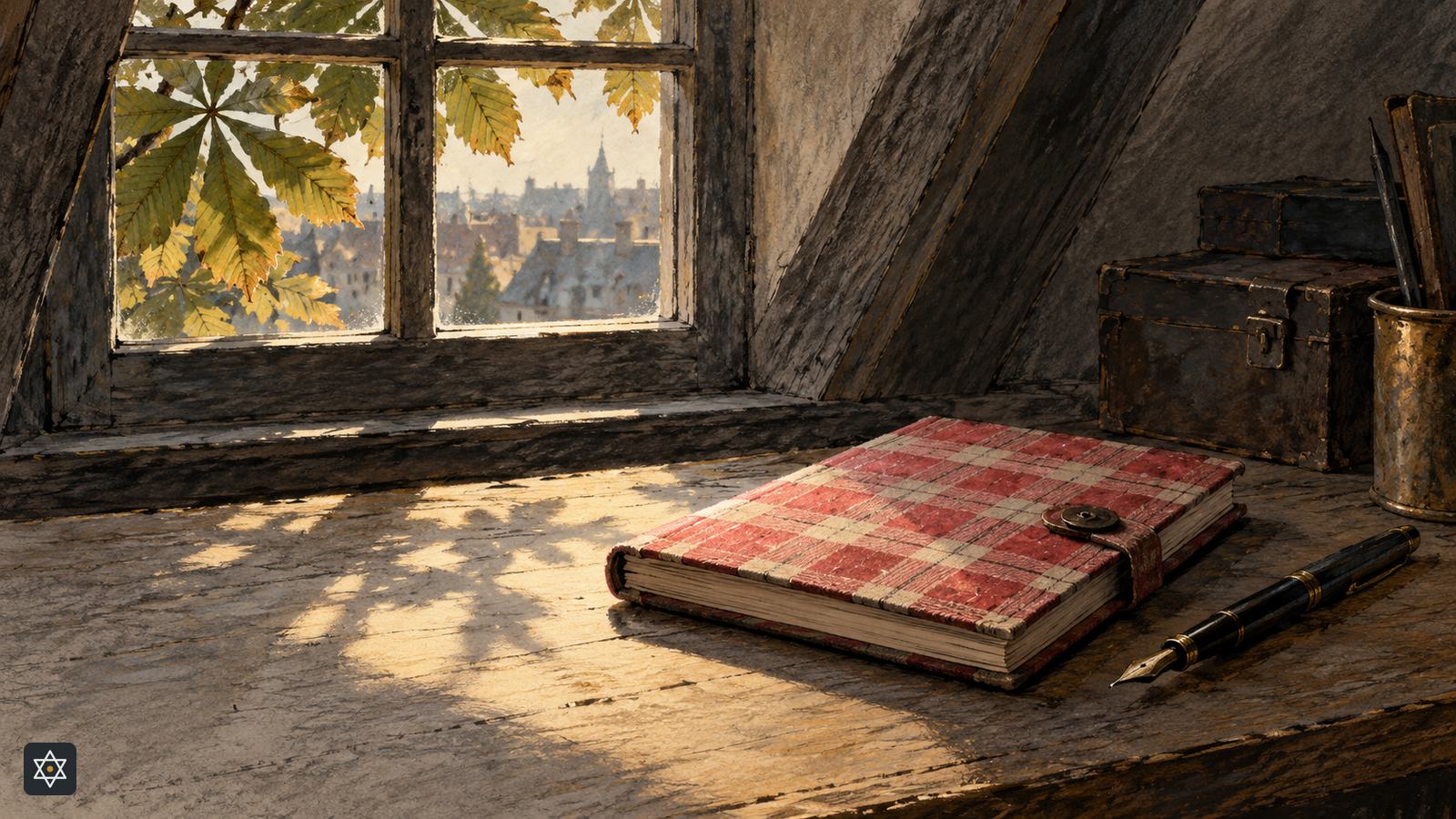
Anne received the red-checked diary for her thirteenth birthday, shortly before going into hiding. Her writing eventually extended across notebooks and loose sheets. She recorded events and feelings, experimented with stories and thought seriously about becoming a writer or journalist. The familiar image of one small book can therefore obscure the amount and variety of writing she produced.
In 1944 she heard a Dutch government-in-exile radio appeal to preserve wartime diaries and documents. She began reworking her entries into a book she called Het Achterhuis, meaning The Annex. This revised manuscript did not simply duplicate the original diary. She selected, expanded and reshaped material for an imagined audience. The surviving original and revised texts show a young author making decisions about narrative and characterization.
Editors commonly distinguish the initial diary as version A and Anne's revision as version B. Otto later drew on both when preparing the first published edition, often called version C. These labels describe stages in the text's history, not competing claims about who wrote it. They help readers understand why editions can differ and why a quotation should be checked against a specified edition and translation.
Reading the work alongside other Holocaust diaries also reveals what makes it distinctive. Anne wrote in hiding, with indirect access to news and no knowledge of how her own story would end. Other diarists wrote in ghettos, camps or under different forms of concealment. No single diary can represent every Jewish experience. Its strength lies in the precision of one voice, not in its ability to stand for all victims.
Arrest and the unresolved question of discovery
Police raided the hiding place on August 4, 1944, and arrested its eight occupants. Two helpers were also arrested. The last surviving diary entry predates the raid, so Anne's own writing cannot explain how the authorities found the annex. Subsequent investigations have examined possible informants and other circumstances surrounding the search, but no conclusive explanation has been established.
The distinction between a hypothesis and a proven accusation is especially important here. Public interest in identifying a betrayer has repeatedly encouraged claims stronger than the surviving evidence supports. In 2022 the Anne Frank House stated that the available information did not justify accusing the person named by a widely publicized “cold case” investigation. It endorsed the need to reject an accusation that could not be substantiated.
Research has also considered whether the raid might have originated in an investigation unrelated to the people in hiding. That possibility does not prove that there was no betrayal; it shows why the cause of discovery remains unresolved. The responsible historical conclusion is limited but clear: the arrest is documented, while the chain of information that led police to the annex is not conclusively known.
Uncertainty about discovery must not be confused with uncertainty about responsibility for persecution. The occupation authorities organized the anti-Jewish measures, arrests and deportations. The absence of a proven informant does not make the wider machinery obscure. It simply marks a gap in the evidence about one event within an extensively documented process.
Westerbork, Auschwitz and Bergen-Belsen
After detention in Amsterdam, the eight people from the annex were sent to Westerbork, the transit camp in the Netherlands. On September 3, 1944, they were deported to Auschwitz-Birkenau. There the men and women were separated. Anne, Margot and Edith entered the women's camp, while Otto was held separately. The family no longer had the limited protection of remaining together in hiding.
Anne and Margot were transferred to Bergen-Belsen in the autumn of 1944. Edith remained at Auschwitz, where she died; Otto survived and was liberated by Soviet forces. The sisters encountered the increasingly catastrophic conditions at Bergen-Belsen, including hunger, cold and disease. Both contracted typhus. Their final months are known through transport documentation and the accounts of people who encountered them, not through a continuation of Anne's diary.
Research published by the Anne Frank House in 2015 concluded that the sisters probably died in February 1945, earlier than the March date long repeated in publications. Their exact dates of death have not been established. The distinction between a probable month and an official date assigned after the war is important: administrative certainty on a certificate does not necessarily reflect a contemporary eyewitness record.
Anne was fifteen when she died. Neither her literary talent nor the later influence of her writing changes the fact that she was denied the adult life she had imagined. The broader history of children and women during the Holocaust shows how deportation and imprisonment destroyed family support and exposed children to lethal conditions across occupied Europe.
Otto Frank and the diary's publication
Miep Gies and Bep Voskuijl recovered Anne's papers after the arrest, before the hiding place was emptied. Miep kept them and later gave them to Otto after he learned that his daughters had died. He was the only one of the eight people from the annex to survive the war. Reading Anne's work confronted him with both her ambitions and parts of her inner life that he had not fully known.
The first Dutch edition of Het Achterhuis appeared in 1947. Otto compiled it from Anne's original and revised writings, making editorial choices that included omissions of personal material. Later editions restored additional passages and made the manuscript history more visible. Scholarly and forensic examination established the authenticity of Anne's writing; editorial differences are not evidence that the diary was fabricated.
Translations, theatrical adaptations and film brought the story to an international audience. Each adaptation made choices about emphasis, dialogue and structure. A stage scene should therefore not be treated automatically as a verbatim historical exchange. Readers seeking Anne's own language need to return to the diary and identify the edition and translation they are using.
Reading Anne Frank without losing her historical world
Anne's observations about people and the future often resonate with readers far beyond the circumstances in which she wrote. That resonance becomes misleading when selected passages are separated from her Jewish identity, the occupation and her murder. A sentence written in hope is not a final comment on events she did not live to record. The diary ends before the deportations that killed her.
Her legacy is strongest when literary attention and historical context remain together. Readers can notice humor, revisions, contradictions and ambition while tracing the restrictions and decisions that shaped her life. They can recognize the helpers without assuming that help was always available, and acknowledge unresolved questions without inventing answers. In this way Anne remains an author and a person, not merely a reassuring symbol extracted from a history of destruction.
Sources
- Anne Frank House, Who Was Anne Frank?, undated
- United States Holocaust Memorial Museum, Anne Frank Biography: Who Was Anne Frank?, undated web article
- Anne Frank House, The Two Versions of Anne’s Diary, undated
- Anne Frank House, The Complete Works of Anne Frank, undated
- Anne Frank House, Anne Frank’s Last Months, March 31, 2015
- Anne Frank House, Statement Cold Case Counter-Investigation, March 23, 2022
- Anne Frank House, The Authenticity of the Diary of Anne Frank, undated