Drancy was the principal internment and transit camp for Jews deported from France during the Holocaust. Established in a housing complex northeast of Paris, it brought together arrests, confinement, registration and transport to Nazi camps, above all Auschwitz-Birkenau. Its history reveals the interaction between German persecution policy and French administrative and police participation.
French officials administered the camp under German supervision until July 1943, when Alois Brunner took direct control. More than 63,000 Jews were deported through Drancy, according to the European Commission's Holocaust memory-site account. Other institutional summaries use approximately 65,000. The figures require attribution, but the camp's central role is clear across the sources.
A housing estate converted into a camp
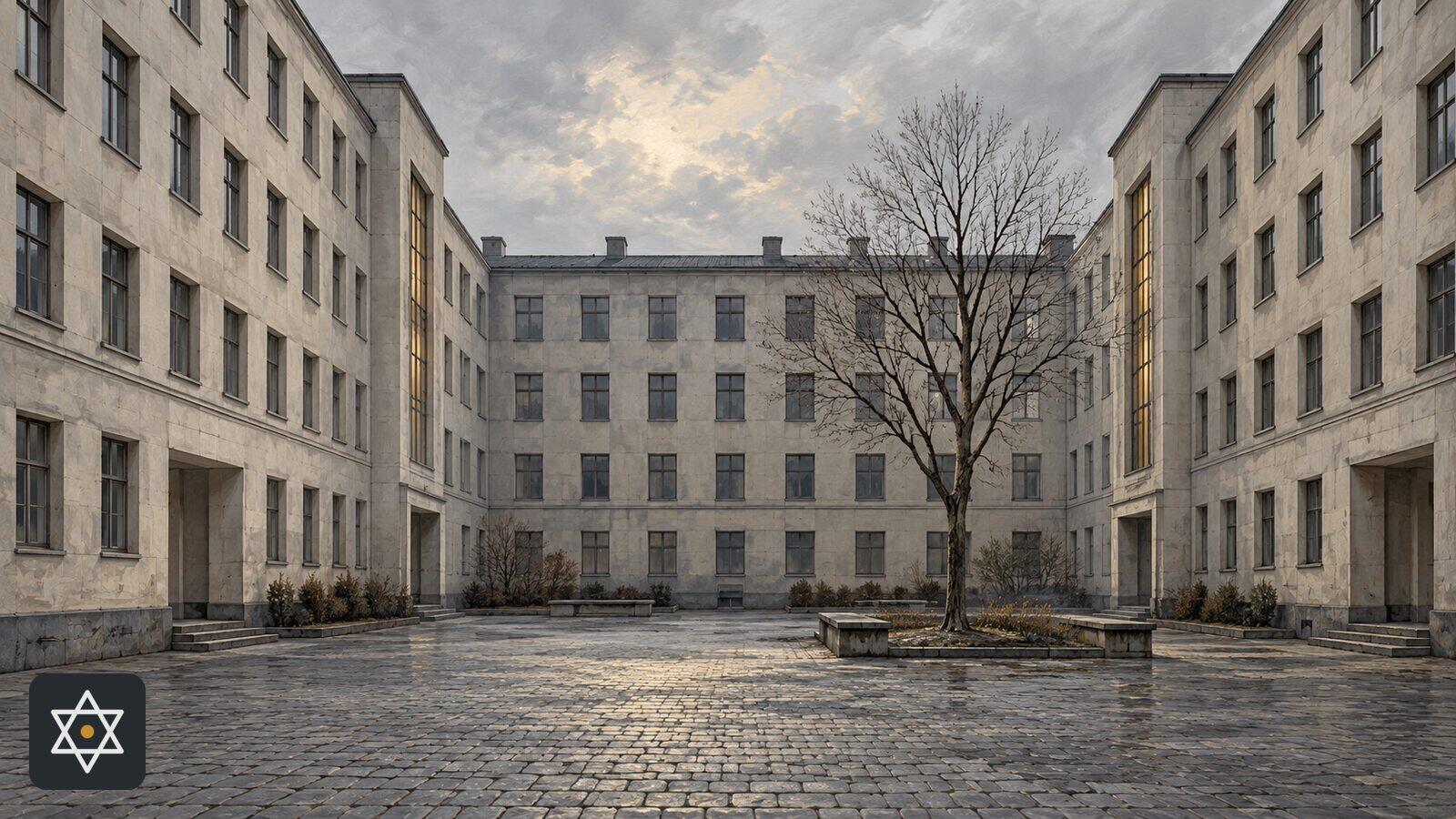
The Cité de la Muette had been designed as modern housing. Its unfinished buildings and enclosed courtyard were repurposed for detention. Beginning in August 1941, Jews arrested in Paris were confined there in conditions far removed from the residential promise of the development.
The setting is historically significant. Drancy was not a remote killing center hidden far from the city. It was an internment site within the urban surroundings of Paris, connected to police operations, offices and nearby railway stations. The transformation of ordinary infrastructure helped make persecution administratively manageable.
Its role developed over time. Internment in 1941 and deportation from 1942 belong to connected but distinguishable phases. The broader page on the Holocaust in France explains the occupation, Vichy policy and the changing geographical reach of persecution that supplied the camp with prisoners.
French administration and German authority
Until July 1943, French officers appointed through the Paris police administration ran Drancy, while German security authorities supervised the camp and controlled the wider deportation program. French gendarmes guarded prisoners. Describing the camp as French-administered does not mean that it operated independently of Nazi objectives.
Conversely, German direction does not erase French participation. Arrest, guarding and confinement depended on institutions and personnel whose decisions had direct consequences for Jews. The historical question is how those responsibilities were distributed and exercised, rather than which single national label can replace the entire chain.
In July 1943, Brunner assumed direct command. French gendarmes continued guarding the outside. The change altered camp management, but deportation had already been underway. It should not be presented as the moment when an otherwise protective institution first became dangerous.
The Vel d'Hiv roundup and the children's route
On July 16 and 17, 1942, French police carried out the Vel d'Hiv roundup in Paris. Those arrested did not all take the same route afterward. Single adults and couples without children were sent directly to Drancy, while many families were confined in the Vélodrome d'Hiver and then transferred to camps in the Loiret.
At Pithiviers and Beaune-la-Rolande, children were separated from their parents. Adults were deported, and the children were subsequently brought to Drancy and sent to Auschwitz. A simplified account in which every family traveled together directly from the stadium to Drancy conceals this sequence of separation.
The children reached a transit system that had already removed their parents. Their presence exposes the inadequacy of administrative descriptions such as transport or transfer. These were coercive movements of people who could not control their destination, accompanied by the destruction of family protection. Their experiences belong within the wider history of children and women during the Holocaust.
The convoys and the railway stations
Drancy's deportees were taken to nearby stations, initially Le Bourget and later Bobigny. Most transports went to Auschwitz-Birkenau, although other destinations also appear in the records. The camp's position in the transport system made it a gathering point for people arrested in different parts of France.
The term transit can suggest a brief, impersonal stop. For prisoners, it meant waiting under guard with little control over what would happen next. A transport list connected an individual name to a date and destination, but it did not describe the person's fear, health or knowledge of the danger ahead.
The page on railway deportations explains the broader machinery. In the Drancy case, distinguishing the internment site from the departure station is particularly useful. A reference to departure from Drancy may identify the camp that assembled the convoy, not a railway platform inside its courtyard.
Internees' lives and the evidence they left
Letters, drawings, graffiti, personal objects and testimony help recover the experience of confinement. They document efforts to communicate with relatives, understand impending transports and preserve some connection to life outside. Their survival also reflects chance, later collection and the work of families and memorial institutions.
The artist Georges Horan-Koiransky, imprisoned in Drancy, produced drawings that the memorial has used to examine camp life. Such works differ from administrative records in purpose and viewpoint. They should be read with their circumstances of creation, rather than treated as interchangeable illustrations of any Holocaust camp.
Different sources answer different questions. A list may establish that a person was deported; a letter may reveal what the writer knew at that moment; testimony may explain an experience recalled later. Combining them makes it possible to move beyond a total number without inventing thoughts or dialogue that the evidence does not preserve.
The final deportations and the end of German control
Even as Allied forces advanced in France, Brunner continued arrests and deportations. The Shoah Memorial records a transport to Auschwitz on July 31, 1944, carrying approximately 1,300 prisoners, including 330 children. The approach of liberation therefore did not automatically protect people already trapped in the camp system.
On August 17, 1944, Brunner left with a final group of 51 prisoners bound for Buchenwald. The memorial describes the camp then passing to representatives of the Resistance under the authority of Swedish consul Raoul Nordling. The remaining internees left over the following days.
Some prisoners preserved the camp's name files despite orders to destroy records. Those acts mattered after the war, when families and investigators needed to trace people who had disappeared through the deportation system. Preserving a record could not reverse a death, but it could prevent a person's fate from becoming wholly untraceable.
Memory in an inhabited landscape
The Shoah Memorial at Drancy opened in 2012 opposite the former camp. Its position allows visitors to see the housing complex while studying its wartime history. The relationship between the exhibition and the still-inhabited surroundings is part of what makes this site distinctive.
The memorial's permanent exhibition brings together documents and the experiences of people interned between 1941 and 1944. The historical place is neither an untouched wartime scene nor merely a symbol detached from evidence.
Drancy demonstrates how persecution moved through a chain of institutions: police arrest, camp administration, railway transport and killing at the destination. Each stage had identifiable participants and records. Reconstructing that chain keeps responsibility visible and restores individual lives to a history often reduced to the departure of convoys.
Sources
- Shoah Memorial: historical questions and Drancy
- Shoah Memorial Drancy: permanent exhibition
- European Holocaust memory sites: Drancy
- Shoah Memorial: the Vel d’Hiv roundup
- Shoah Memorial Drancy: exhibition on the Vel d’Hiv roundup
- Shoah Memorial: liberation of Drancy
- Fondation pour la Mémoire de la Shoah: Drancy memorial