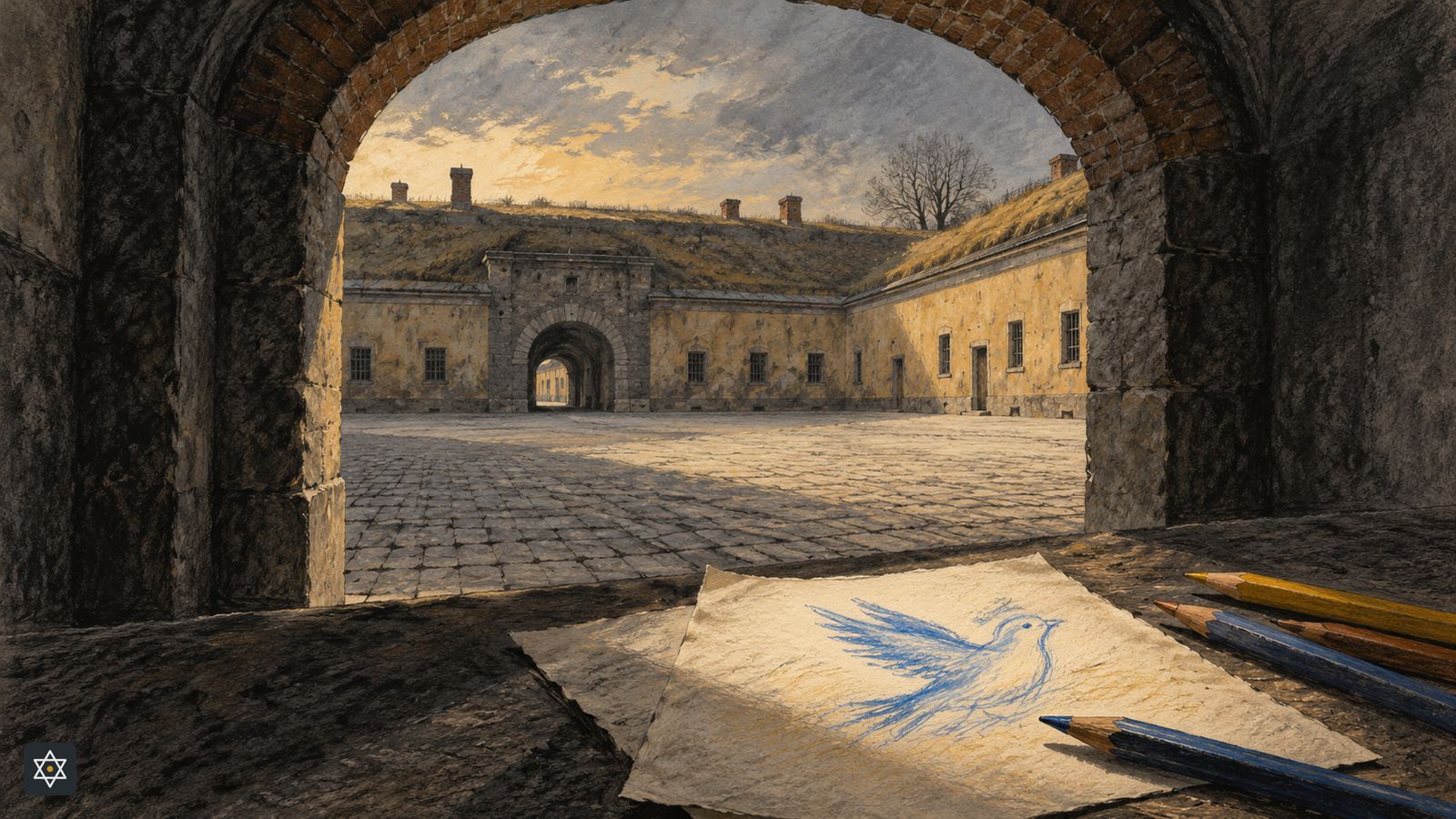
Theresienstadt was a ghetto established by Nazi Germany in the Czech town of Terezín in November 1941. It held Jews from the occupied Czech lands, Germany, Austria and other countries, served as a transit point for deportations to killing sites, and became an instrument of Nazi propaganda. Hunger, disease and overcrowding killed thousands within the ghetto. Most people deported onward were murdered elsewhere.
The existence of concerts, lectures, children's drawings and a carefully staged international visit has sometimes distorted the history of the place. These activities did not make Theresienstadt a safe refuge. Cultural work expressed prisoners' efforts to sustain human life under confinement; Nazi propaganda selectively exploited that life to conceal persecution. Understanding the ghetto requires keeping its internal conditions, its transport connections and its manufactured public image in view at the same time.
A fortified town turned into a ghetto
Terezín stood in the Protectorate of Bohemia and Moravia, the territory under German occupation in the Czech lands. The town's barracks and enclosed layout made it suitable for the mass confinement envisaged by the authorities. On November 24, 1941, the first group of 342 Czech Jewish men arrived from Prague to prepare the site. Larger systematic transports followed. The removal of the town's non-Jewish residents eventually placed the entire main town at the disposal of the ghetto administration.
The ghetto in the main fortress must be distinguished from the nearby Small Fortress, which the Gestapo used as a prison. Both belonged to the landscape of Nazi persecution at Terezín, but they were different institutions with different prisoner populations and records. Confusing them can lead to errors about where a person was held or which deaths a statistic includes. The name of the town alone is therefore not enough to identify a prisoner's circumstances.
The SS retained decisive authority. A Jewish Council of Elders and administrative departments were forced to organize many aspects of daily life, including housing, work and food distribution. Their responsibilities existed within coercive limits set by the perpetrators. Managing scarcity under threat did not give Jewish administrators control over the policies that produced that scarcity or over the deportation system. Their difficult decisions need to be studied without treating them as equivalent to those of the authorities who imprisoned the population.
Who was sent to Theresienstadt
Czech Jews made up the largest national group. From 1942, transports also brought many German and Austrian Jews, including elderly people and decorated veterans of the First World War. Some had been encouraged to believe that they were entering a retirement settlement. The actual destination offered inadequate accommodation, insufficient food and exposure to disease. Older people were especially vulnerable to this abrupt destruction of the support and resources on which their lives had depended.
The designation of Theresienstadt for certain elderly or “prominent” Jews served the regime's administrative and propaganda purposes. It did not provide reliable protection from death or onward deportation. Many gifted musicians, teachers and artists were there simply because they were Jews caught in the deportation of their communities, rather than because the Nazis had selected a cultural elite for special treatment. That distinction helps explain the ghetto's artistic life without adopting the perpetrators' preferred image of the place.
The history of German Jews under Nazi persecution shows the losses that preceded these deportations: exclusion from employment, dispossession, enforced moves and the destruction of community institutions. Arrival at Theresienstadt was not the beginning of persecution. For many people it was a further stage after years of diminishing security, often accompanied by separation from relatives who had emigrated or been deported to other destinations.
Hunger, illness and the work of maintaining life
Barracks and other buildings became severely overcrowded. Privacy disappeared, food was insufficient and sanitary facilities could not meet the population's needs. Disease spread among people already weakened by hunger and exhaustion. Elderly prisoners suffered particularly high mortality, although no age group was exempt from danger. The US Holocaust Memorial Museum estimates that approximately 34,000 people died in the ghetto.
Doctors, nurses, caregivers and other prisoners tried to organize medical treatment and daily assistance with inadequate resources. Their work should be understood as an effort against the conditions of imprisonment, not as evidence that those conditions were acceptable. A functioning kitchen, infirmary or classroom could coexist with hunger and death because the people running it were attempting to limit damage they had no power to end.
The distribution of food, space and work could create painful inequalities and conflicts. Recording those conflicts does not undermine accounts of solidarity. It shows what prolonged deprivation did to a population compelled to live within boundaries it had not chosen. A responsible history leaves room for both forms of experience: the help people offered and the relationships that coercion and scarcity placed under strain.
Deportations beyond the ghetto
Theresienstadt was not a final destination for most of those imprisoned there. The first transport east departed for Riga on January 9, 1942. Later transports went to other ghettos and killing sites, including Treblinka and Auschwitz-Birkenau. Elderly German and Austrian Jews were among those sent to Treblinka in 1942. The category that had brought them to an “old-age ghetto” did not prevent their murder.
The US Holocaust Memorial Museum's current overview gives approximately 88,000 people deported onward and approximately 3,500 survivors among those deportees. These are estimates describing a particular group: they are not the number of all people who survived imprisonment in Theresienstadt. More than 140,000 Jews were confined in the ghetto before the additional arrivals associated with the final evacuations of other camps. The figures should not be combined without attention to these different populations.
Transport orders transformed daily life even before a train departed. A relative, teacher or fellow performer could disappear from the community with little warning. People tried to obtain information, remain with family members or avoid inclusion in a transport. Their knowledge of the destination was limited and changed over time. The history of railway deportations explains how administrative lists and transport arrangements became instruments of mass murder.
A particularly destructive series of transports in autumn 1944 removed much of the ghetto's remaining population to Auschwitz. Many people involved in its cultural life were among those murdered. The chronological connection matters: a performance or drawing made in Theresienstadt can be followed almost immediately in the historical record by the deportation of its creator.
Children's education, art and writing
Prisoners organized educational and cultural activities despite confinement. Children learned, drew, wrote and participated in performances. These efforts offered relationships and intellectual activity in a setting designed to deny ordinary childhood. They could not remove hunger, separation or the threat of deportation. The wider history of children and women during the Holocaust places these experiences within the destruction of families across occupied Europe.
The artist Friedl Dicker-Brandeis taught children and encouraged them to express themselves through drawing and painting. Their surviving work includes imagined landscapes, remembered homes and observations of the world around them. A child's image need not be a literal depiction of a camp scene to be historically meaningful. Its value may lie in what the child remembered, hoped for or chose to create within confinement.
Children performed Hans Krása's opera Brundibár, while adults organized concerts, lectures and theatrical productions. The young writer Petr Ginz helped produce the magazine Vedem. Such works preserve distinctive voices and interests rather than a single collective statement. Like other Holocaust diaries and personal writing, they require attention to authorship, date, audience and survival history. They should not be mined only for uplifting phrases detached from the fate of their creators.
Culture at Theresienstadt was neither a Nazi gift nor proof of humane treatment. Prisoners created meaning under coercion. The authorities could tolerate, restrict or appropriate their activity without changing the fundamental relationship between captor and captive. Both truths belong in the history: the creativity was real, and its use in propaganda was deceptive.
The Red Cross visit and the propaganda film
On June 23, 1944, an international delegation including a representative of the International Committee of the Red Cross and Danish representatives visited Theresienstadt. Pressure concerning the fate of Danish Jews helped bring about the visit. The authorities prepared a controlled route and a misleading presentation of life in the ghetto. Buildings were improved for display, activities were staged and overcrowding was reduced through deportations.
The visit therefore cannot be treated as an unrestricted inspection. What observers were permitted to see had been selected by the perpetrators, while prisoners remained under their power. The resulting favorable impression illustrates a fundamental problem of evidence: a visitor may accurately describe a scene without understanding how that scene was constructed or what has been removed from view.
Later in 1944 the Nazis produced a propaganda film using ghetto prisoners, with the filmmaker Kurt Gerron compelled to participate in its production. Images of work, leisure and performance concealed the conditions of imprisonment and the ongoing murder of Jews. Gerron and many of the people filmed were subsequently deported and murdered. The film's surviving fragments are evidence of Nazi deception, not an unmediated record of ordinary, freely chosen life.
Liberation and the responsibility of remembrance
In the final weeks of the war, prisoners evacuated from other camps arrived at Theresienstadt in desperate condition. Disease, including typhus, added to the emergency. The International Committee of the Red Cross assumed responsibility shortly before Soviet forces arrived on May 8, 1945. Liberation ended Nazi control, but medical care and recovery remained urgent. Freedom did not immediately restore health or reveal what had happened to missing relatives.
Today the history of Theresienstadt depends on transport records, administrative documents, testimony, drawings, music and surviving buildings. Each kind of evidence answers different questions. A transport list can establish a route; a diary can reveal how one person experienced waiting; a propaganda film can show what the perpetrators wanted outsiders to believe. Reading them together prevents any single image from becoming the whole story.
Theresienstadt's cultural legacy deserves preservation because it records people living and creating under extraordinary constraint. It must remain connected to the hunger, deaths and deportations that surrounded it. Remembering the children's art while forgetting the transport system would reproduce part of the separation on which Nazi propaganda depended. The historical task is to restore those connections and the individual lives they reveal.
Sources
- United States Holocaust Memorial Museum, The Theresienstadt (Terezín) Ghetto, undated web article
- United States Holocaust Memorial Museum, Theresienstadt: Key Dates, undated web article
- United States Holocaust Memorial Museum, Cultural Life in the Theresienstadt Ghetto, undated web article
- United States Holocaust Memorial Museum, Theresienstadt as a Tool of Nazi Propaganda: The Red Cross Visit, 1944, undated web article