The Sonderkommando at Auschwitz-Birkenau consisted mainly of Jewish prisoners forced by the SS to work at the camp's killing installations. They were compelled to perform tasks connected with the disposal of the murdered, under the constant threat of death themselves. The SS organized and carried out the mass murder. Assigning prisoners to its aftermath did not transfer responsibility to those prisoners.
Some members nevertheless managed to leave evidence: photographs taken secretly, writings concealed in the ground and testimony given after liberation. Others participated in the revolt of October 7, 1944. These sources make it possible to study both the killing process and the efforts of people trapped inside it to communicate with a future they could scarcely expect to see.
Who the prisoners were
Sonderkommando means "special detachment," but the German authorities used that designation for different units. The prisoner work squads at Birkenau must not be confused with German killing units bearing the same word. The name alone does not identify who commanded, who killed or who was a prisoner.
Men were selected from arriving transports or transferred from other prisoner groups. They generally did not know what their assignment would involve before entering it. Their work took place within the larger system of Auschwitz-Birkenau, where the SS controlled movement, food, punishment and survival. Refusal did not offer a safe alternative.
The prisoners were isolated because they knew how the killing installations operated. The SS murdered members of the work squads and replaced them with new arrivals. There was no universal, reliably enforced timetable that allowed a prisoner to calculate how long he would live. Changes in staffing, transports and the operation of the crematoria affected the immediate danger.
Conditions under extreme coercion
Some Sonderkommando prisoners had access to food or clothing taken from deportees and lived under conditions that differed from those elsewhere in the camp. These material differences have sometimes distorted discussion of their position. They existed alongside enforced participation in unbearable work, separation from other prisoners and the knowledge that the SS intended to eliminate witnesses.
Survival depended on circumstances over which a prisoner had little control. Access to a particular workplace, an unexpected transfer or help from another prisoner could matter. Such possibilities cannot be treated as free choices between ordinary alternatives. A historical account must identify the decisions available to the SS and distinguish them from the drastically restricted actions available to prisoners.
The Nazis' efforts to conceal mass murder extended beyond Birkenau. Aktion 1005 involved other coerced prisoner units in the destruction of evidence at killing sites. The circumstances and personnel differed, but both histories show why the regime targeted witnesses as well as physical traces.
Four photographs taken in secret
In the summer of 1944, members of the Sonderkommando helped take four clandestine photographs near a Birkenau crematorium. Research associates the photographer with the Greek Jewish prisoner Alberto Errera, known to fellow prisoners as Alex. Other prisoners assisted by watching the surroundings, obtaining equipment or helping the film reach contacts outside the immediate work area.
The photographs were not the work of an observer with unrestricted access. Their hurried framing, dark borders and unusual angles belong to the evidence of how they were made. They record fragments of an operation whose SS organizers sought to keep its most incriminating stages from public view. Their historical value does not require graphic reproduction.
Cropping the images too tightly can remove information about concealment and danger. A photograph's margins may reveal that the camera was held from a sheltered position or used without time to compose the scene. The sequence, the surviving messages about the film and testimony concerning the operation help establish what the images can support.
Writings buried for future readers
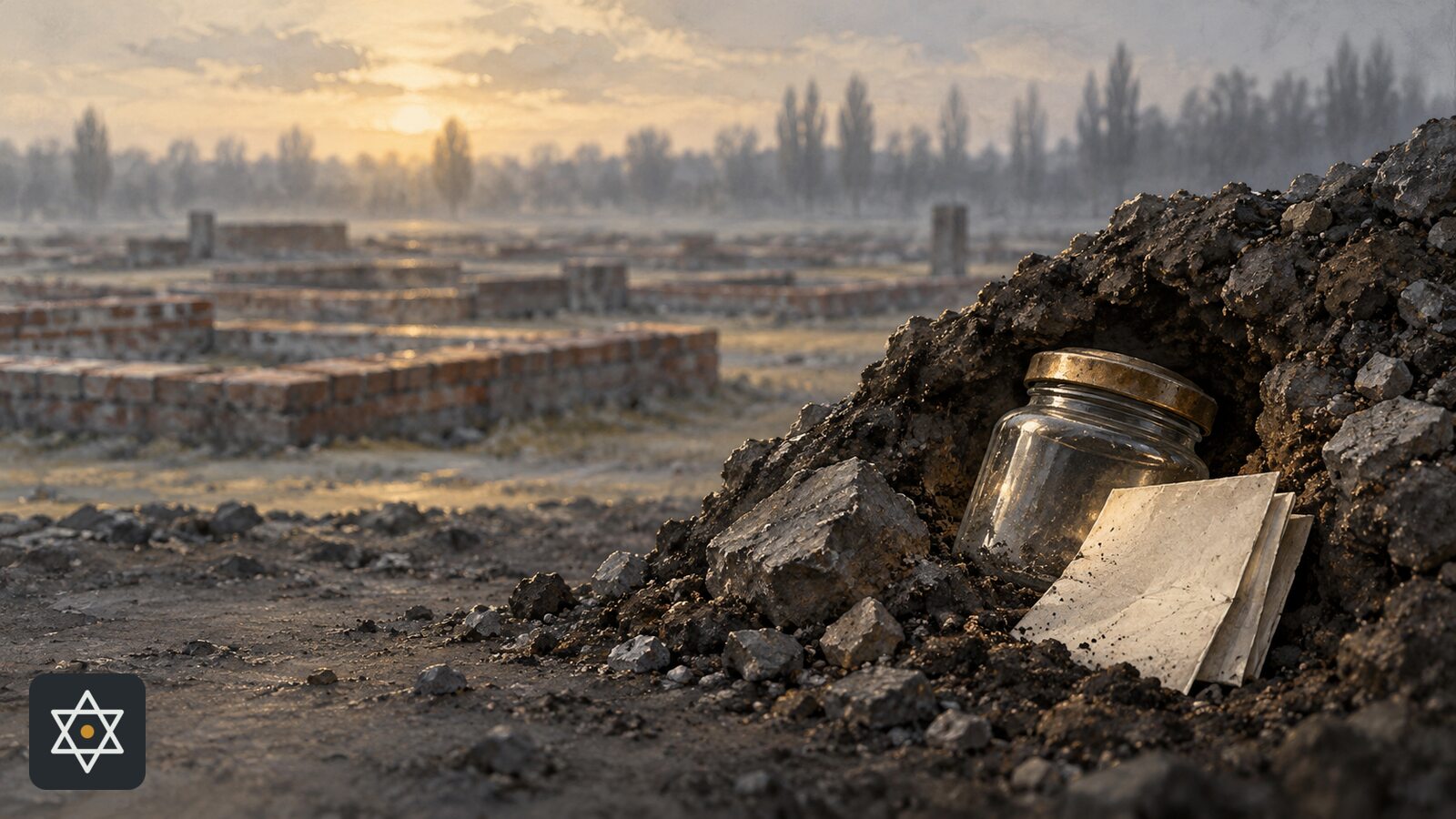
Several prisoners wrote accounts and concealed them near the killing installations. Among the authors were Zalmen Gradowski, Zalmen Lewental and Leib Langfus. Their texts differ in form and purpose: observation, reflection, appeals to future readers and attempts to preserve the names and experiences of the murdered.
The writings did not reach historians as a complete, orderly archive. Containers failed, paper deteriorated and discoveries took place at different times. Missing passages and damaged pages require careful transcription and comparison. A gap in a manuscript is a limitation of the surviving object, not permission to supply the author's unwritten words.
The manuscript of Marcel Nadjari offers a particularly clear example. Written in November 1944 and discovered in 1980, it suffered severe damage from moisture. Conservation and multispectral imaging later recovered text that had been difficult to read. The history of that recovery is part of the document's provenance: researchers must distinguish the original writing, later decipherment and editorial translation.
The revolt of October 7, 1944
On October 7, 1944, Sonderkommando prisoners rose against the SS. They set fire to Crematorium IV and attempted to escape. The revolt disrupted the operation of the killing installations, but it could not overcome the armed camp system surrounding the prisoners.
Women prisoners working in a munitions factory had secretly supplied gunpowder. The resistance network included Róża Robota, Ala Gertner, Estera Wajcblum and Regina Safirsztajn, whose names appear in different spellings in the sources. The SS subsequently executed the four women. Their involvement shows that the revolt depended on cooperation across workplaces and prisoner groups, not only on the men at the crematoria.
The Auschwitz-Birkenau State Museum records approximately 250 prisoners killed during the fighting; the US Holocaust Memorial Museum also describes about 200 killed afterward. These figures refer to different stages of the suppression. They should not be presented as competing estimates of the same moment. The museum's account of prisoner mutinies places the revolt within the camp's wider history of resistance.
Testimony, interpretation and responsibility
Survivors later described experiences that official German documents obscured or reduced to administrative language. Their accounts contain differences in viewpoint, chronology and remembered detail. Historians examine those differences alongside manuscripts, photographs, camp records and the surviving site, using the same critical principles applied to other Holocaust evidence.
Public discussion has sometimes demanded explanations from Sonderkommando survivors that it would never demand from other people held under immediate threat of death. Historical scrutiny does not require such a moral presumption. It requires attention to coercion, the limits of a witness's knowledge and the circumstances in which an account was recorded.
The surviving evidence also restores differences among individuals whom the SS treated as disposable labor. Some wrote; some helped others write; some photographed, planned resistance or survived to testify. Their actions did not remove the power of the perpetrators. They preserved traces of people and events the perpetrators intended to erase.
Sources
- USHMM: Sonderkommandos
- Auschwitz-Birkenau State Museum: prisoner mutinies
- USHMM: Auschwitz revolt
- Auschwitz Museum: writings and clandestine evidence
- Auschwitz Museum: clandestine photographs and resistance
- Auschwitz Museum: Marcel Nadjari manuscript and conservation
- National Library of Poland: conservation and multispectral recovery of Nadjari manuscript
- Auschwitz Museum: surviving sources and their significance