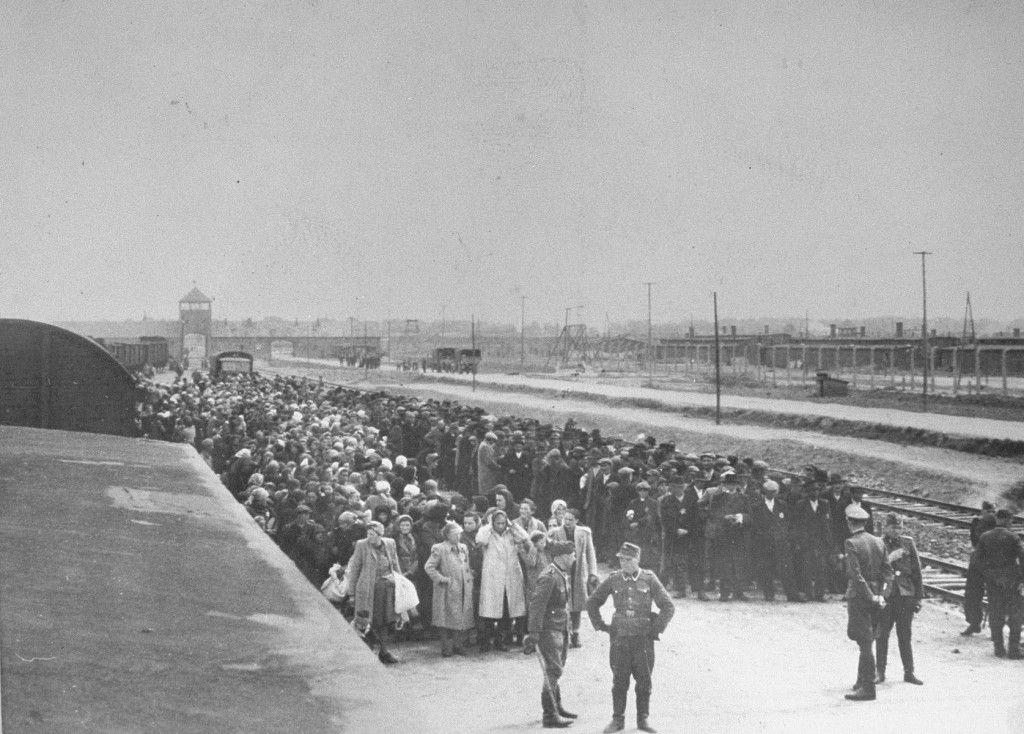
View original source at USHMM
The complex
Auschwitz I functioned as the administrative center and concentration camp. Auschwitz II-Birkenau became the principal killing site while also holding registered prisoners. Auschwitz III-Monowitz supplied forced labor to IG Farben, and the complex expanded through numerous subcamps.
Murder, selection and forced labor
Deportation transports arrived from across occupied Europe. Many deportees were selected on arrival for immediate murder; others were registered for forced labor. Gas chambers and crematoria at Birkenau became central to the killing process. Approximately 1.1 million people were murdered in the Auschwitz complex, around one million of them Jews. Other victim groups included Poles, Roma and Sinti, Soviet POWs and prisoners of many nationalities.
Resistance, evacuation and liberation
Prisoners resisted in many ways. On October 7, 1944, members of the Sonderkommando revolted and damaged a crematorium. As Soviet forces approached, the SS evacuated tens of thousands of prisoners on death marches. Soviet troops liberated the camp on January 27, 1945 and found approximately 7,000 prisoners left behind. Many camp records had been destroyed, which is why the absence of a person’s name from a surviving list cannot be treated as proof that the person was never there.
Additional context on the Auschwitz complex
Multiple camps
Auschwitz I, Birkenau, Monowitz and subcamps had distinct functions within one complex.
Registered and unregistered victims
Many Jews selected for immediate murder were never registered as prisoners.
Deportation and selection
Deportees arrived from across Europe; the Hungarian deportations of 1944 were among the largest waves.
Resistance and evidence
The Vrba–Wetzler escape, clandestine Sonderkommando photographs and the October 1944 revolt are central to evidence and resistance history.
Sources
This page is an educational synthesis based on the following sources. Consult the full sources for deeper research.