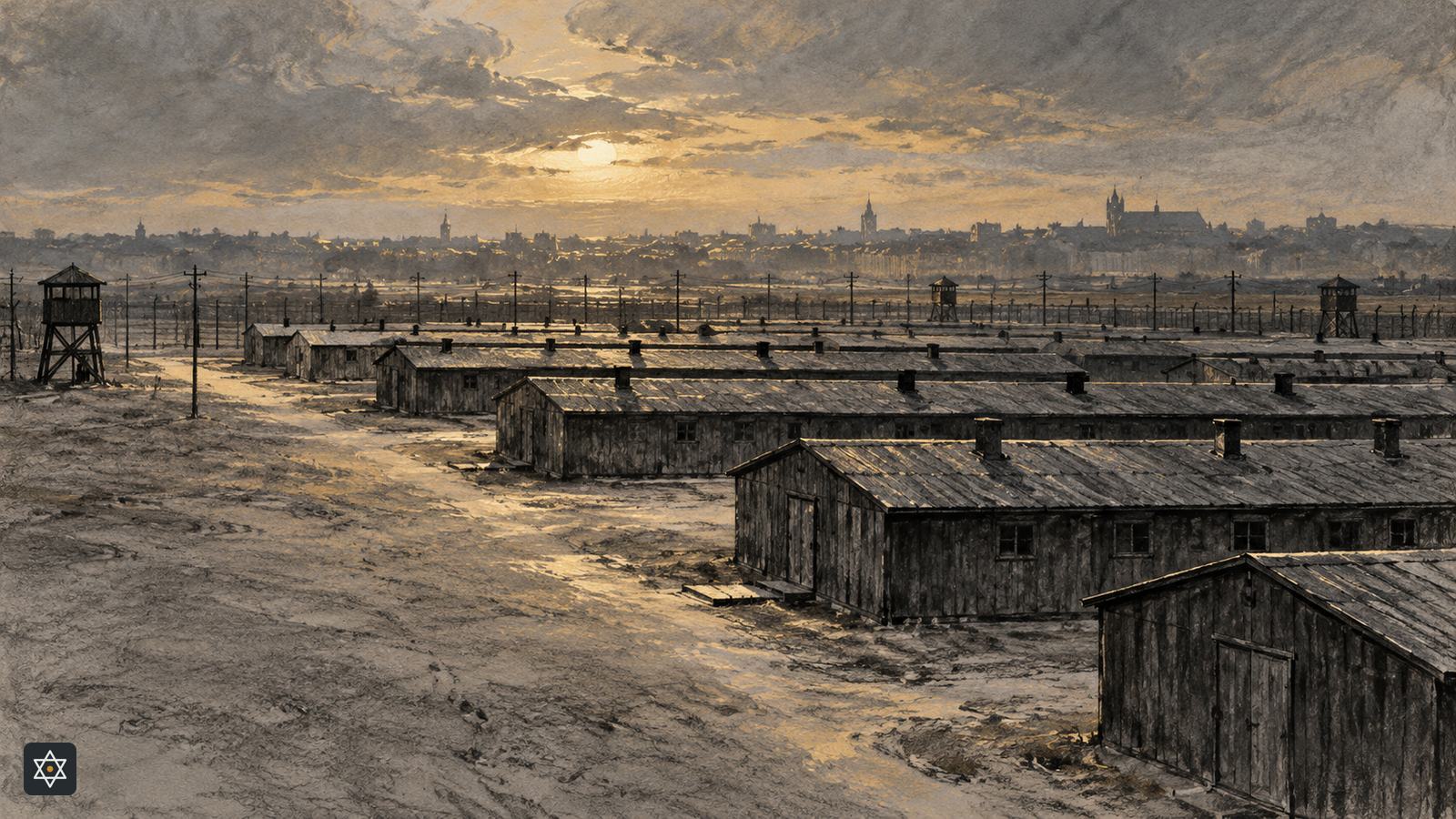
Majdanek was a German concentration camp on the outskirts of occupied Lublin, in eastern Poland, where imprisonment, forced labor and mass murder operated together. Established in 1941, it held Jews and non-Jews from many countries. People died from deliberate deprivation and brutal treatment, and were murdered in gas chambers and shootings. On November 3, 1943, the SS and police murdered approximately 18,000 Jews at the camp in a single day.
Soviet forces reached Majdanek in July 1944 and found much of its physical infrastructure still standing. The camp consequently became an early, internationally visible source of evidence about Nazi crimes. Its historical importance also includes a lesson about counting victims: research by the State Museum at Majdanek substantially revised earlier death estimates. The current scholarly figure of approximately 78,000 deaths, including about 60,000 Jews, rests on investigation of records and prisoner populations, rather than on assumptions about the maximum capacity of killing facilities.
A camp beside an occupied city
The name Majdanek derived from the nearby Lublin district of Majdan Tatarski. The SS officially designated the institution a prisoner-of-war camp before renaming it concentration camp Lublin, or KL Lublin, in 1943. These administrative names should not be mistaken for a complete description of its population. From the beginning, the camp developed within a wider system of occupation, exploitation and persecution. Its purposes changed as German policies and military circumstances changed.
Construction began in autumn 1941. Soviet prisoners of war were among those forced to build the camp under lethal conditions. The vast expansion envisaged by the SS was never fully completed, but the built camp became a major institution in the Lublin region. Barracks, fences, guard towers and work areas stood close to the city. Majdanek was not concealed in an inaccessible wilderness. Its proximity to ordinary roads and civilian life is important when considering what different people could see, know or choose to ignore.
The institution belonged to the concentration camp system while also serving regional SS plans. Lublin was central to the German occupation of Poland and to the murder of Polish Jews. Understanding this setting requires the wider history of the Holocaust in occupied Poland. The camp cannot be understood solely through its remaining buildings, because decisions made in offices elsewhere determined who arrived, what work they performed and whether they would be killed.
Prisoners and the organization of deprivation
The State Museum describes prisoners originating from nearly 30 countries. Jews constituted the largest group of victims. Other prisoners included Poles, Soviet citizens and people deported from occupied parts of eastern and western Europe. Nationality, religion, the SS classification assigned to a prisoner and the circumstances of arrest all affected treatment. None of these categories made confinement safe, but the Nazi project to murder Jews imposed a particular and systematic danger on Jewish prisoners.
Women were imprisoned at Majdanek from 1942, and children also passed through the camp. The presence of different groups should not suggest a stable community with equal conditions. Prisoners arrived through different deportation operations and at different stages of the camp's history. Some were held for a comparatively short period before transfer. Others remained until death, escape or evacuation. A transport list therefore records a moment in a person's history, not necessarily the place where that history ended.
Forced labor exhausted people whose food, clothing and shelter were already inadequate. Disease spread through overcrowding and poor sanitation. Violence, punishment and selections compounded the damage. Describing these deaths as merely the result of wartime shortages would conceal responsibility. The authorities confined people, controlled provisions and work, and maintained conditions that predictably killed them. The language of administration often obscures this agency, especially when a record reduces a person to an entry for illness or transfer.
Prisoners nevertheless attempted to help one another, maintain relationships and preserve evidence of their experiences. Their actions took place under restrictions that varied by prisoner group and period. Survival cannot be explained as a simple reward for resourcefulness, health or solidarity. Decisions by guards, access to a work assignment, transfers and chance repeatedly overturned any protection a prisoner had managed to obtain.
Gas chambers and the camp's overlapping functions
Majdanek had gas chambers in which the SS murdered prisoners. The killing installations used carbon monoxide and hydrogen cyanide released from Zyklon B. Selections and shootings formed additional parts of the murder process. A history focused only on the chambers would omit the many people killed through other means; a history focused only on forced labor would erase deliberate, organized murder.
The distinction between a concentration camp and a killing center is therefore useful, but it must not become a rigid rule that prevents description of overlapping functions. Bełżec, Sobibór and Treblinka were established primarily for the immediate murder of deported Jews. Majdanek had a registered prisoner population and extensive imprisonment and labor functions alongside mass killing. The broader account of camps and killing centers explains why both institutional purpose and actual practice matter.
Majdanek was connected to Operation Reinhard, the German operation to murder Jews in the General Government. It served the exploitation and murder of Jews and the handling of stolen property within the Lublin region. This connection does not make every camp in the region administratively identical. Historians distinguish command structures, prisoner records and killing operations precisely because these distinctions reveal how the system worked.
Surviving rooms and equipment must likewise be interpreted through documentation. A building's present appearance is not, by itself, proof of every use it had during the war. Museum research brings together construction records, testimony, administrative documents and material investigation. This combination makes the site historically legible without asking visitors to infer an entire murder operation from a single visible object.
November 3, 1943: the mass shooting at Majdanek
The largest single killing action at Majdanek took place during the operation the perpetrators called “Erntefest,” meaning “Harvest Festival.” On November 3, 1943, SS and police units murdered approximately 18,000 Jews at the camp. The victims included Jewish prisoners of Majdanek and Jews brought from other Lublin camps. Trenches had been prepared, and the operation was organized to carry out mass shooting on an enormous scale.
The Majdanek massacre formed part of a broader operation on November 3–4 in the Lublin district, during which approximately 42,000 Jews were murdered. That larger figure includes victims at other sites, notably Trawniki and Poniatowa. It must not be presented as the number murdered at Majdanek alone. The distinction between the local and regional totals is essential both for accurate accounting and for understanding the coordination of the crime.
The shootings destroyed most of the remaining Jewish forced-labor population in the affected camps. They also expose the limits of explanations that assume the Nazis always preserved labor they considered economically useful. Jewish workers could be exploited and then murdered in a planned operation. Their capacity to work did not override the regime's determination to destroy Jewish life.
The dedicated account of Aktion Erntefest provides the regional framework. Within Majdanek's history, November 3 marks a decisive rupture in the prisoner population. It also demonstrates why a single overall death figure needs to be accompanied by a chronology: mass shootings, gassings and deaths during imprisonment had different documentary traces and cannot be reconstructed through one kind of record alone.
Evacuation, Soviet arrival and an exposed crime scene
As the eastern front approached in 1944, the SS transferred and evacuated prisoners westward. Liberation did not reach everyone who had been imprisoned at Majdanek. Some had already been sent to other camps, where they faced further forced labor, death marches and murder. A family tracing a relative must therefore distinguish release from Majdanek's control from actual freedom.
Soviet troops reached the camp in July 1944. Majdanek was the first major Nazi concentration camp liberated, and much of its infrastructure remained available for examination. The Germans had attempted to destroy evidence, including by burning the crematorium, but had not dismantled the entire site. “Largely intact” describes the survival of substantial evidence; it does not mean that every wartime installation survived unchanged or that all records remained available.
Investigators, journalists and other visitors encountered a site that made Nazi crimes visible before the war had ended. Reports and photographs circulated internationally. Their production during wartime requires the same attention to authorship, purpose and corroboration as other sources. That requirement does not diminish the physical evidence or survivor testimony. It explains how historians distinguish an observed fact from an early estimate, an interpretation or a claim made before a full investigation was possible.
Why the estimated death toll changed
Early estimates placed the death toll at Majdanek in the hundreds of thousands. Later research reduced those figures as historians gained access to more records and reconstructed the camp's population more carefully. Tomasz Kranz's study, published in 2005 in the State Museum's research journal, estimated approximately 78,000 victims, including approximately 59,000 Jews. Museum summaries commonly round the Jewish figure to about 60,000.
The research examined such evidence as death registrations, camp documentation, transport information and testimony. These sources have gaps, and people murdered without ordinary registration cannot be counted simply by adding surviving death certificates. Conversely, estimates derived from the theoretical capacity of facilities can greatly exceed the number of people actually brought to and killed at a site. Responsible reconstruction checks the possible population against multiple independent bodies of evidence.
A revision is not a change in the moral or historical character of the crime. It is a correction to a particular numerical claim. The gas chambers, mass shooting of November 3, fatal conditions and persecution of prisoners remain documented. Accurate figures make it possible to distinguish victims at Majdanek from those murdered at other places and to avoid counting the same people twice.
For readers and educators, the useful question is therefore not whether an older figure appeared in print, but what evidence supported it and what later research established. Majdanek demonstrates both the durability of evidence about Nazi mass murder and the necessity of revising specific conclusions. Preserving the site and identifying its victims are connected tasks: neither the buildings nor the numbers should stand in for the people whose lives were destroyed there.
Identifying one additional person also matters within the discussion of totals. A name can help a family connect successive places of imprisonment, distinguish people with similar names or clarify an incompletely recorded transfer. Population research and individual research are complementary: a carefully reconstructed life can correct the understanding of the larger group.
Sources
- State Museum at Majdanek, Ogólny zarys historii, undated
- Auschwitz-Birkenau State Museum, Majdanek Victims Enumerated: Changes in the History Textbooks, December 23, 2005
- Tomasz Kranz, research on mortality at KL Lublin, Zeszyty Majdanka 23, 2005, cited through the Auschwitz-Birkenau State Museum
- State Museum at Majdanek, Operacja Erntefest, undated