The trial of Adolf Eichmann opened in Jerusalem on April 11, 1961, and ended with his conviction and death sentence in December. Eichmann had directed the office within the Nazi security apparatus responsible for coordinating many deportations of Jews. Captured by Israeli agents in Argentina in 1960, he was tried under Israel's 1950 law for punishing Nazis and Nazi collaborators. After his appeal failed, he was executed during the night of May 31–June 1, 1962.
The proceedings were both a criminal trial of one defendant and a major public encounter with the history of the Holocaust. Documents connected Eichmann to the machinery of persecution, while survivor witnesses described experiences that reached far beyond his immediate presence. The trial changed the scale and prominence of public listening in Israel and abroad. It did not create survivor testimony from nothing, and its historical importance should not obscure the judges' separate task of deciding criminal responsibility on the evidence.
Eichmann's place in the deportation machinery
Eichmann headed section IV B 4, the office dealing with Jewish affairs and deportation within the Reich Security Main Office. The RSHA brought together central institutions of Nazi security and police power. Eichmann was not the sole architect of the Holocaust, nor did one office independently control every murder operation. His importance lay in coordinating and implementing policies through an extensive administrative network.
Deportation required communication among police offices, occupation authorities, railway officials and other agencies. Identifying victims, assembling transports and arranging destinations connected bureaucratic decisions to imprisonment and murder. The fact that a perpetrator worked through papers and meetings did not place his actions outside the crime. The trial examined that connection between administrative activity and its consequences for the people deported.
Eichmann participated in the Wannsee Conference in January 1942 and prepared its record under Reinhard Heydrich's direction. The conference belonged to the coordination of the “Final Solution”, not the beginning of all anti-Jewish persecution or the first act of mass murder. Recognizing the chronology prevents a familiar meeting from becoming an explanation for a process already underway.
In 1944 Eichmann and his staff played a central role in the deportation of Hungarian Jews, working with Hungarian authorities after the German occupation. The history of the Holocaust in Hungary demonstrates both his initiative and the participation of other institutions. Individual responsibility becomes clearer when those connections are traced, rather than when one defendant is made to stand for every perpetrator.
Argentina, capture and the sovereignty dispute
After the war Eichmann escaped Europe and lived in Argentina under the name Ricardo Klement. Information about his whereabouts eventually reached Israeli authorities, with the German prosecutor Fritz Bauer playing an important role in bringing information forward. Israeli agents captured him in May 1960 and secretly took him to Israel. The operation was not an ordinary extradition carried out with Argentine consent.
Argentina protested the violation of its sovereignty, and the dispute reached the United Nations Security Council. The issue concerned one state's agents operating on another state's territory without permission. It was distinct from the question of whether Eichmann had committed the crimes alleged against him. Acknowledging the sovereignty dispute does not require treating his criminal responsibility as uncertain; the two questions belong to different legal inquiries.
Israel and Argentina subsequently resolved their diplomatic dispute. The manner of capture nevertheless remained part of the debate surrounding the proceedings. It raised questions about how a state could bring a fugitive to justice when an ordinary transfer had not taken place. The courtroom then had to address whether the circumstances of his arrival prevented the Israeli court from trying him.
The capture also transformed a hidden postwar life into a public legal case. Investigators faced the task of reconstructing decisions made across many countries nearly two decades earlier. That required far more than identification of the man in custody. They collected documents, examined witnesses and compared Eichmann's accounts with the administrative record of his wartime work.
The court, the indictment and the defense
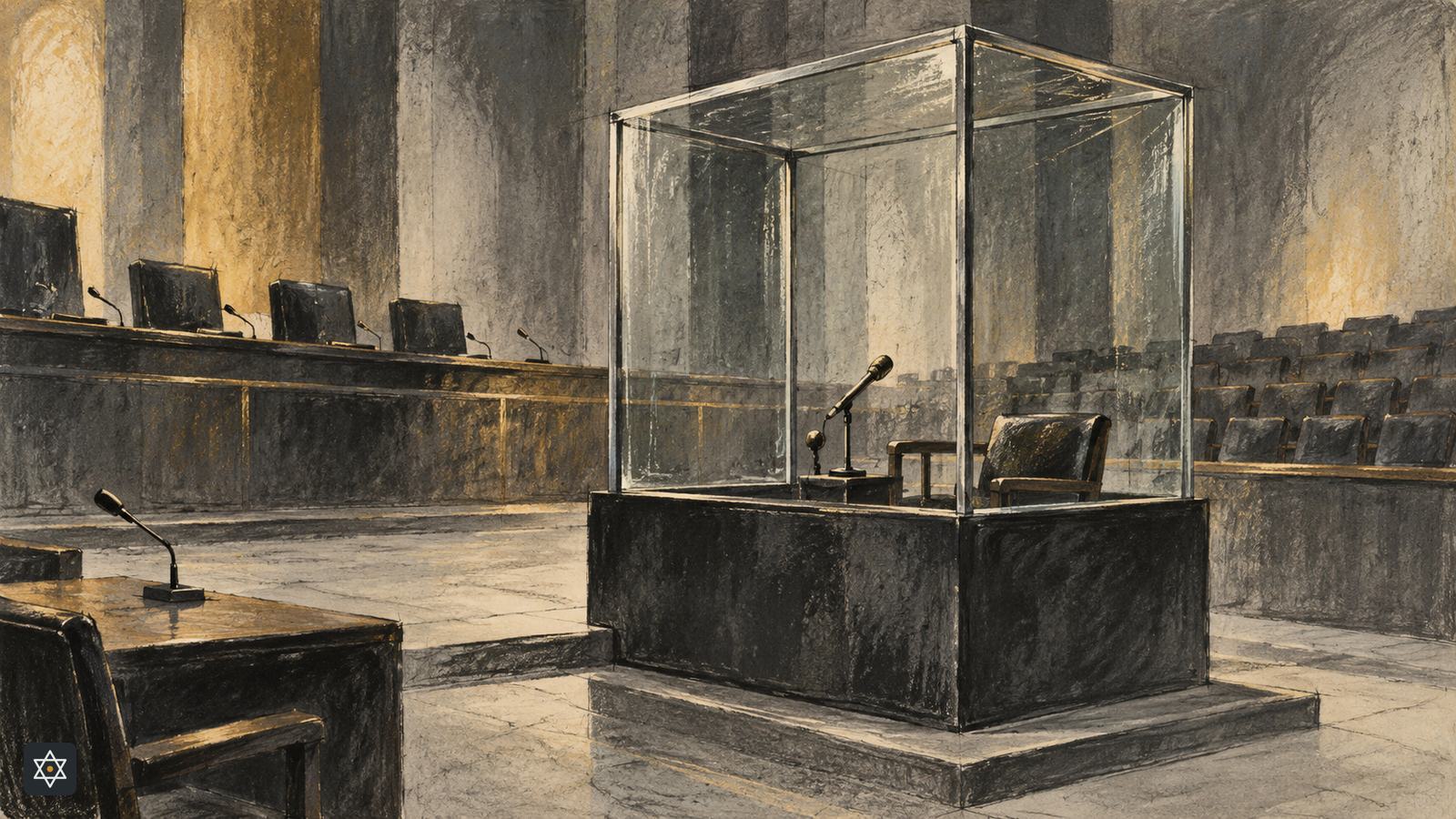
The case was heard by the Jerusalem District Court, sitting at Beit Ha'am in a specially arranged courtroom. Moshe Landau presided with judges Benjamin Halevi and Yitzhak Raveh. Attorney General Gideon Hausner led the prosecution, while the German lawyer Robert Servatius represented Eichmann. The defendant sat in a protective glass enclosure, an image that became strongly associated with the trial.
The indictment contained fifteen counts under the Nazis and Nazi Collaborators (Punishment) Law of 1950. They included crimes against the Jewish people, crimes against humanity and war crimes, as well as organizational offenses. The law allowed an Israeli court to address conduct committed before the state's establishment and outside its territory. Those features were central to the jurisdictional and retrospective-law arguments raised by the defense.
The court rejected challenges to its authority. Its reasoning drew on the character of the crimes and the legal principles governing their punishment. A historical account should distinguish the judges' conclusions from the objections made against them. Reporting that a defense argument existed does not mean the court accepted it; reporting the ruling does not erase the fact that the issue was contested.
Eichmann portrayed himself as an official carrying out orders rather than a decision-maker responsible for their consequences. The prosecution and court examined this claim against documents and testimony about his knowledge, initiative and role. Administrative subordination did not by itself establish innocence. The legal question was what he had knowingly contributed to the persecution and destruction of people.
Documents and the voices of survivors
The prosecution presented an extensive documentary record, including material showing deportation arrangements and the operation of Nazi institutions. Written evidence was essential to linking Eichmann to particular policies and actions. Survivor testimony did not replace that record. It added personal accounts of what persecution meant in places that official language often reduced to offices, destinations and transport figures.
More than one hundred witnesses appeared, many of them Holocaust survivors. The prosecution sought to make the destruction of European Jewish life audible through different experiences: ghettos, camps, hiding, deportation and resistance. Not every witness had encountered Eichmann personally. This raised a tension between the broad historical narrative presented by the prosecution and the narrower requirement to prove the defendant's responsibility.
Witnesses included Zivia Lubetkin, associated with the Warsaw ghetto resistance, and Abba Kovner, who spoke about Vilna. Henryk Ross brought knowledge and photographs from the Łódź ghetto. Their testimony did not offer one uniform experience. It showed differences in place, chronology and the possibilities available to Jews facing persecution. The public heard identifiable people recounting events, rather than only numerical summaries of losses.
Testimony also carried the difficulties of memory, language and speaking publicly about traumatic events. Courts needed specific answers, while a survivor's experience might not fit neatly into a prosecutor's question. The value of testimony does not depend on pretending it has no limitations. It lies in careful attention to what a witness knew directly, what was learned later and how the account relates to other evidence.
Judgment, appeal and execution
The court delivered its conviction in December 1961 and imposed a death sentence on December 15. The judges found that Eichmann had been a central participant in the persecution and murder of Jews, rejecting his attempt to reduce his role to morally and legally neutral obedience. The judgment addressed his conduct within a system without allowing the system to dissolve his individual responsibility.
Eichmann appealed to Israel's Supreme Court, which upheld the conviction and sentence in May 1962. A request for clemency was rejected. He was executed by hanging at Ramla prison during the night of May 31–June 1, 1962. His body was cremated, and the ashes were scattered at sea beyond Israeli territorial waters. The sequence matters: the district court's sentence was followed by an appeal and a separate clemency process.
The death sentence itself generated disagreement, including among people who did not dispute Eichmann's guilt. Arguments about punishment concerned the response to the crime, not necessarily its occurrence. Distinguishing those positions avoids turning every criticism of the execution into a denial of responsibility. The public debate formed part of the trial's aftermath and of broader questions about justice after mass murder.
A change in public listening
The proceedings received extensive international coverage through reporting, radio and filmed material shown abroad. In Israel, radio broadcasts brought the courtroom into daily life. The voices of survivors reached listeners who might previously have encountered the Holocaust mainly through public ceremonies, military narratives, documents or fragmented family knowledge. The trial connected individual accounts to a widely shared national event.
It would nevertheless be inaccurate to describe the years before 1961 as complete silence. Survivors had already written memoirs, testified, organized commemorations and built institutions. Families and communities had their own forms of remembrance. The change lay in the prominence, reach and authority given to survivor accounts, not in the first existence of those accounts. The history of the Holocaust and Israel requires both continuity and change.
The trial also challenged simplistic questions about why Jews had not resisted. Accounts of ghettos and camps exposed the conditions under which decisions had been made and the many forms of effort to preserve life. Public understanding did not change uniformly or immediately, but the proceedings widened the space in which survivors could be heard as witnesses to history rather than judged against expectations formed outside their circumstances.
Interpretation, controversy and the record that remains
Hannah Arendt's reporting and her later book Eichmann in Jerusalem generated a major debate, especially around her formulation of the “banality of evil” and her discussion of Jewish leadership under coercion. These were interpretations offered by an observer and political thinker, not findings issued by the court. The phrase should not be used to certify Eichmann's self-presentation as an innocent bureaucratic instrument. His claims were tested and rejected in the judgment.
Later historical research has continued to examine his ideological commitment, wartime actions and postwar statements. The existence of an influential interpretation does not close those questions. Readers need to distinguish evidence about what Eichmann did and believed from broader arguments about bureaucracy, obedience and human judgment. A concise slogan cannot carry the full burden of either the biography or the trial.
The surviving record includes filmed testimony, police interrogation, documents, arguments and judicial decisions. Each item should be identified by its role in the case. A prosecutor's opening is advocacy; a witness's account is testimony; a judgment records the court's findings and reasoning. Reading them together preserves the trial as both a legal proceeding and a historical event.
The Eichmann trial's lasting importance lies in that combination. It established responsibility for a major participant in the deportation machinery and created a widely shared encounter with survivors' accounts. Its power does not depend on treating one defendant as the whole Holocaust or one courtroom as the beginning of all remembrance. It depends on the connections the proceedings made visible between institutions, individual actions and the lives destroyed by them.
Sources
- Yad Vashem, Eichmann’s Trial in Jerusalem, undated exhibition
- United States Holocaust Memorial Museum, Eichmann Trial, undated web article
- National Library of Israel, The Trial of Adolf Eichmann: Record of Proceedings in the District Court of Jerusalem, catalog entry for official record
- Yad Vashem and Israel State Archives, The Eichmann Trial exhibition and filmed proceedings, undated digital presentation